What Are Real-Time Payments? A Guide (November 2026)
The Ultimate Guide to Real-Time Payments (RTP)
Until recently, processing financial transactions was relatively slow. You could initiate a transfer quickly through bank-to-bank transfers, debit cards, or credit cards. But settlement took much longer, often hours or several business days depending on the method and bank communication. Now the technology exists to settle your transactions instantly.
We're talking about real-time payments (RTPs), also called instant payments or immediate payments. Instead of waiting days for funds to clear, RTPs settle around the clock, letting small businesses move money faster than before. The result is better cash flow for companies and faster access to funds for payment recipients.
Here's what real-time payments are and how they can benefit your business.
TLDR:
- RTPs settle account-to-account in seconds, 24/7/365, and can't be reversed once sent.
- The U.S. has 2 rails: The Clearing House's RTP Network (2017) and FedNow (2023), each supporting up to $10 million per payment.
- Use RTP for urgent one-off payouts; use ACH for scheduled batches like payroll.
- Irrevocability raises fraud risk: add velocity checks and payee validation before sending.
- Dots routes each payment to the right rail automatically via its payout API.
A Quick Definition
First things first: What are real-time payments?
It's all in the name! RTPs are account-to-account transfers that process in real time. These transfers settle immediately and continuously, 24 hours a day, 365 days a year. RTP systems provide immediate fund availability to payment recipients, removing the old standard of waiting several business days for transactions to settle. Exact timing varies, but most RTPs process within seconds, and account balances typically reflect changes just as quickly.
Because RTPs are so fast, these transactions are irrevocable. Payers can't deauthorize or cancel a transfer once they initiate it.
RTP vs. RTPS: Avoiding Confusion
Search for "RTPS meaning" and you may land outside finance. In payments, RTP means Real-Time Payments, while RTPS has three unrelated uses.
Real-Time Publish-Subscribe is a wire protocol that moves data between components in robotics and software systems such as DDS and ROS 2. Real-Time Polling Service is a quality-of-service class in WiMAX networks that reserves bandwidth for streaming traffic. Real-Time Playback System is a label for media and simulation tools that replay content live. None of these relate to moving money between bank accounts.
Evolution and Relevance in Modern Financial Ecosystems
The modern financial transaction world looks nothing like it did in decades past. Businesses and consumers went from relying on cash and paper checks to debit and credit cards to perform transactions. Now, we have secure chip technology and the ability to send money in numerous ways. You can turn to a bank to initiate transfers, but you can also do it all from a smartphone, use digital wallet services, and more.
RTPs are the newest evolution in financial transactions, and it's a long time coming. In the United States, it's still young.
However, the roots of this technology go back several decades. The earliest RTP systems date back to the 1970s and 1980s in countries like Japan and Switzerland.
True real-time payments weren't available for the United States until well into the new millennium. The Federal Reserve announced plans to improve how fast payments move in the United States in 2012. It took several years for the organization to develop strategies and form a task force to make it happen.
Meanwhile, The Clearing House led the charge in the private sector. In 2017, The Clearing House launched its real-time payments network, the RTP network. The Federal Reserve went live with its RTP rail, FedNow, in 2023.
The technology has changed a great deal over the last few decades. Earlier networks were capable of processing and settling transactions at real-time speeds. However, they faced limitations outside business hours, weekends, and holidays. Today, RTP networks largely operate around the clock, allowing small businesses, large enterprises, and individual consumers to send funds instantly at any time.
Real-time payments are now live in dozens of countries across every inhabited continent. Comparatively, the United States lagged in adopting a true RTP network, as governments in several countries created networks well before the U.S.
The U.S. is catching up as more banks, credit unions, and other financial institutions join The RTP Network and FedNow. Adoption continues to grow each year as participation expands across the country.
RTPs are becoming more relevant with every passing year, and it's not hard to see why. From a consumer perspective, RTPs provide convenience and accessibility, eliminating the multiday wait periods of yesteryear. Meanwhile, businesses have much to gain from RTPs. Whether performing business-to-business transactions or paying contractors, the speed of RTP networks is a game-changer in countless industries.
How Real-Time Payments Work and Why They Matter
How Do They Work?
Real-time payments operate on advanced networks. Transactions occur on new infrastructure built for the digital world. This infrastructure processes transactions far faster than a standard electronic fund transfer (EFT), an Automated Clearing House (ACH) transfer, or even same-day ACH. How do real-time payments work?
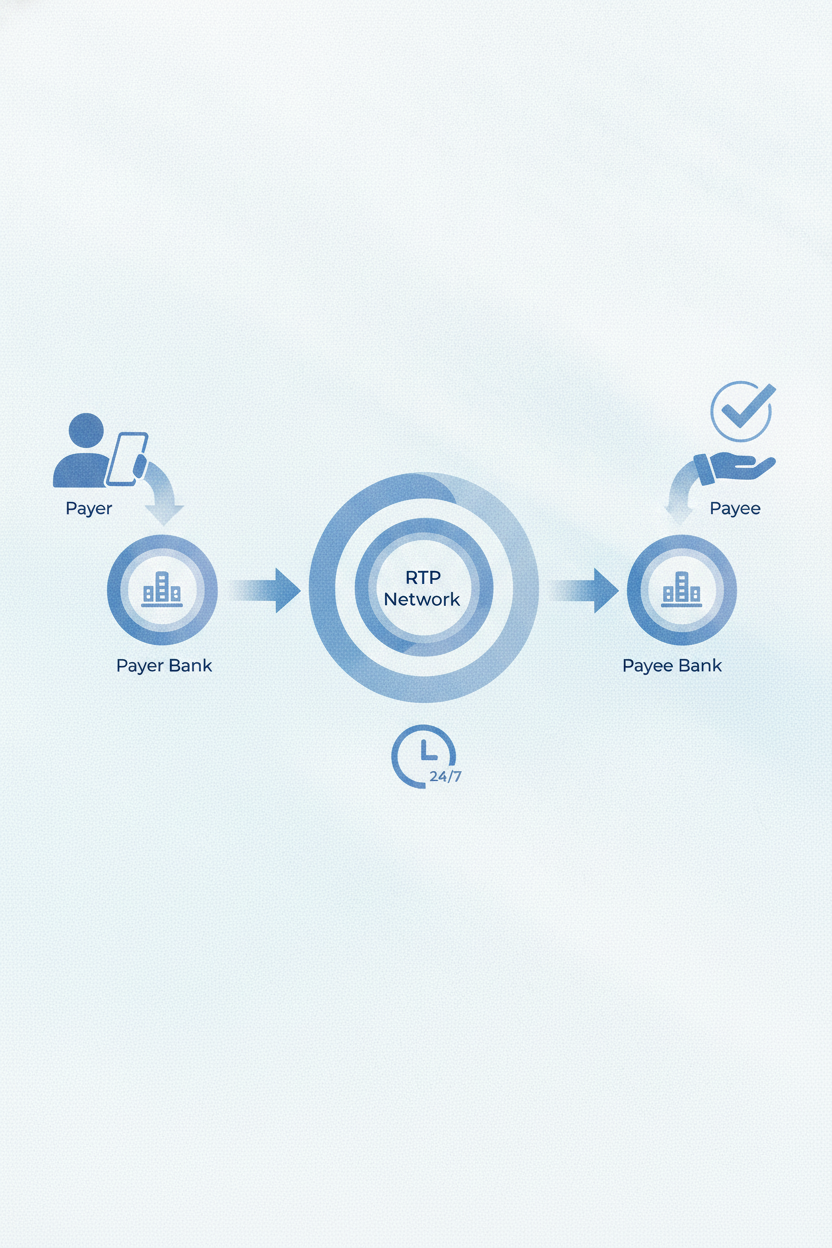
To understand how RTPs are possible, you need to understand the parties involved.
• Payer: The payer is the individual or company that initiates the funds transfer. This party is sending money to a recipient and must start the transaction.
• Payer Financial Institution: The payer's financial institution is responsible for authenticating and authorizing the RTP.
• Payee: The payee is the individual or company set to receive funds through an RTP.
• Payee Financial Institution: The payee's bank, credit union, or other financial institution receives payment information for the RTP and makes funds available to the recipient.
• Real-Time Payment Network: The RTP network is where data exchange occurs. It's a central network operated by a group of banks or a financial authority and is how financial institutions communicate to process real-time payments.
Let's demystify the process of real-time payments step by step.
• Step 1 - Initiation: RTPs start with initiation. The payee must initiate a real-time payment where accepted. That can be at a physical bank branch or a financial institution's online portal/app. Like any other type of financial transaction, payees can provide personally identifiable information like bank account numbers and names. However, payees can also set up RTP transactions via more modern methods like QR codes.
• Step 2 - Authentication: After initiating the RTP, the payee's bank authenticates several details. First, the financial institution verifies the payee's identity. Then, it verifies that the payee has enough funds in their account to perform the transaction.
• Step 3 - Transaction Authorization: If authentication is successful, the payee's financial institution authorizes the transaction. It sends payment instructions to the payee's bank via the RTP network. While banks authorize other transaction methods in batches, either once at the end of the day or several times during business hours, they authorize RTPs individually and in real-time.
• Step 4 - RTP Processing: Next, the financial institutions for the payer and payee communicate through the RTP network. The payee's bank receives payment instructions, validates the message, and accepts the payment.
• Step 5 - Notification and Settlement: The transaction settles once the RTP network finishes processing. The payer's bank debits the payer's account, and the payee's bank credits the recipient for immediate access. Both parties get a confirmation by text, email, or push notification.
Real-Time Payments vs. ACH vs. Wire Transfers
Rail | Settlement Speed | Availability | Reversibility | Typical Use Case | Transaction Limits |
|---|---|---|---|---|---|
RTP / FedNow | Seconds | 24/7/365 | Irrevocable | Urgent one-off payouts | Up to $10 million per payment |
Standard ACH | 1 to 3 business days | Business days only | Limited returns, such as errors | Payroll and recurring bills | Set by your bank |
Same-Day ACH | Same business day | Business days, set windows | Limited returns, such as errors | Time-sensitive batches | $1 million per payment |
Wire Transfer | Same day, within hours | Business hours | Generally irrevocable | Large one-off transfers | Set by your bank |
What are the Benefits?
Real-time payments give consumers, businesses, and financial institutions faster access to funds, less reconciliation work, and immediate payment confirmation.
The biggest perk is faster access to funds. You can send or receive money in seconds, about as fast as handing over cash. As a recipient, your business gains stronger cash flow, and as a payer, you give contractors and freelancers a better experience. Here's what that looks like in practice:
- A gig economy service pays drivers or freelancers seconds after a completed job instead of on a weekly cycle.
- A business sends an urgent same-day vendor payment to avoid a late fee or lock in a time-sensitive deal.
- A consumer splits a dinner bill or sends emergency funds to family that arrive instantly instead of in 1 to 3 days.
RTPs also help improve productivity and cut down on payout busywork. Companies like yours benefit from less manual follow-up and reconciliation work thanks to the immediacy of RTPs. RTPs simplify how you send money, possibly unveiling new opportunities to expand your business and optimize productivity.
Finally, RTPs offer stronger transaction certainty. Each payment carries rich data and an immediate confirmation, so you no longer wait to confirm money reached its destination. That data also makes accounting, invoice matching, and payment reconciliation far easier.
Risks and Challenges of Real-Time Payments
Instant settlement brings trade-offs you should plan for:
- Irrevocability: Fraudulent or mistaken payments are hard to recover once sent.
- Authentication: Strong multi-factor authentication and tokenization are needed to block unauthorized transfers.
- Liquidity: Funds leave the payer's account instantly, so weak cash planning can cause shortfalls.
- 24/7 operations: Banks must staff and monitor their systems around the clock.
Real-Time Payments vs. ACH Payments
ACH (Automated Clearing House) transfers process in batches and settle the same day or in 1 to 3 business days. RTPs settle one payment at a time, in seconds, as the comparison table above shows.
ACH suits recurring, scheduled, or batch payments like payroll runs. RTP fits urgent, one-off payouts where speed counts. Most businesses use both and pick the rail per payment.
Major RTP Networks Around the World
Dozens of real-time payment rails operate worldwide, and consumers and businesses reach them through a participating bank or provider, not directly. The major networks include:
- The RTP Network, The Clearing House (2017): Supports payments up to $10 million.
- FedNow Service, Federal Reserve (2023): Settles between Federal Reserve master accounts with no pre-funding.
- Zengin System, Japan (1973): One of the oldest real-time systems, running 24/7 since 2018.
- Faster Payments, UK (2008): Handles most UK online and mobile bank transfers.
- UPI, India (2016): Mobile-first payments sent by phone number or QR code.
In the United States, there are two RTP platforms. These include The RTP Network, owned and operated by The Clearing House, and The FedNow Service from the United States Federal Reserve.
The RTP Network
The Clearing House's RTP Network launched in 2017 and was the first instant payment rail available in the United States. It led the charge for RTPs throughout the country, causing a sharp rise in demand.
This platform allows participating financial institutions to integrate their infrastructures into the network. Transactions through this RTP rail settle through a pre-funded joint master account held at the Federal Reserve Bank of New York. What's unique about The RTP Network is that it requires all participating institutions to pre-fund the joint account and maintain a sufficient balance to meet liquidity needs.
The FedNow Service
FedNow went live in 2023. The United States Federal Reserve owns and operates the network, which processes instant payments all day, every day. Most FedNow payments settle within seconds.
This payment rail also offers better liquidity management for participating financial institutions. FedNow has no funding requirements, either. Transactions through this rail settle between Federal Reserve Bank master accounts. Financial institutions can also do liquidity management transfers (LMTs) for bank-to-bank funding.
Comparison of Popular Systems and Their Features
Let's look closer at the difference between FedNow and The RTP Network.

Both rails offer instant processing and immediate availability of funds. There are some differences between the two for participating financial institutions, particularly regarding pre-funded accounts. However, the two networks operate identically from a consumer or business standpoint. That said, there are a few differences you should know about.
Cycle Day
FedNow's cycle lasts from 7:00 A.M. to 7:00 P.M. the next day. Meanwhile, The RTP Network is from 12:00 a.m. to 11:59 p.m. the next day.
Capabilities
Consumers and businesses can use both rails to send money, request payment, or request the return of funds. However, only FedNow can do liquidity management transfers for bank-to-bank funding.
Max Transfer Amounts
Both the RTP Network and the FedNow Service now support payments up to $10 million per transaction, though individual banks can set lower limits for their customers. Pricing for RTP transactions is set by each bank or financial institution instead of a fixed network fee.
Common Challenges and Strategies for Overcoming Them
There's much to love about real-time payments. However, this newer payment rail does come with some challenges.
The biggest is an increased risk of fraud. This challenge exists because RTPs process so fast. They're irrevocable for a reason. Payments settle so fast that it's impossible to cancel or deauthorize them after initiation.
That's a problem because it leaves little room for businesses and financial institutions to detect fraudulent activity. Companies must adopt concrete measures to mitigate risks, including velocity checks, device fingerprinting, and real-time transaction monitoring that screen each payment before it is sent. Investing in these tools can prevent criminal activity before RTP initiation begins.
Another challenge is evolving regulations. This problem affects businesses operating in different jurisdictions, moving RTPs across borders. Because rules vary worldwide, it's important to understand regulations and take steps to comply fully. That may mean working with attorneys and regulators to guarantee full legal compliance for businesses.
New Ideas in Instant Payment Technology
Widespread adoption is still early. More people are realizing RTP's potential and applying it to many use cases, and the growth will only continue. However, that doesn't mean new development is stopping.
New technology is on the horizon to improve instant payments. The biggest advance in the financial world is full interoperability with different systems. Currently, the two available payment rails operate independently in the United States, and financial institutions must participate in the networks to make the service available to members. RTP systems struggle to interact smoothly with other payments domestically and internationally.
Efforts from the Society for Worldwide Interbank Financial Telecommunications (SWIFT) are working to link domestic instant payment systems so cross-border transfers can move with the same speed as local ones. Both U.S. rails, the RTP Network and FedNow, already use the ISO 20022 message standard, which carries richer payment data and makes connecting separate systems easier. Request-for-payment messages add another piece, letting a payee ask a payer to send funds directly over the rail instead of waiting on an invoice. Together, these pieces lay the groundwork for instant payments that cross borders as easily as they cross banks.
Compliance Requirements for Real-Time Payment Providers
As mentioned earlier, financial institutions must participate in networks to provide access to RTP payment rails. However, they must meet certain eligibility requirements to become real-time payment providers. The compliance requirements for the RTP Network and FedNow Service are similar.
The Clearing House only allows federally insured U.S. depository institutions to join the RTP Network. Qualifying institutions may connect to the network directly or through third-party service providers.
Institutions must be eligible to maintain a master account with a Federal Reserve Bank to join FedNow. Payment companies and other non-bank organizations can't participate in FedNow directly but can become service providers or agents for qualified financial institutions.
How to Start Sending Real-Time Payments
Follow these steps to prepare your business before you send a real-time payment:
- Confirm your bank or payout provider connects to the RTP Network or FedNow.
- Check the per-payment limit your bank sets, since the networks allow up to $10 million per payment.
- Add fraud controls such as velocity checks and payee account validation before sending, since payments can't be reversed once sent.
- Decide which payouts go on RTP versus ACH, sending urgent one-off payments on RTP and scheduled batches like payroll on ACH.
A payout API like Dots routes each payment to the right rail automatically.
International Collaboration and Interoperability
Instant payments are available in many countries around the world. Next to FedNow and RTP in the United States, widely used networks in other countries include:
• The Faster Payment System (FPS) in the United Kingdom
• Immediate Payment Service (IMPS) in India
• Pix in Brazil
• Swish in Sweden
• New Payments Platform (NPP) in Australia
• The Zengin System in Japan
• PayNow in Singapore
• PesaLink in Kenya
RTP payment rails are becoming more widely used. However, governments develop systems and networks to operate domestically. Currently, these networks have no true interoperability. Even in the United States, the two available rails have no interoperability. You can't move transactions between the RTP Network and FedNow service. It's either one or the other.
That lack of interoperability also means you can't initiate RTPs internationally. However, that may change in the not-too-distant future. Collaboration among countries may pave the way to global real-time payments. Many organizations, including SWIFT, are actively developing technologies to support instant payments across borders.
One concrete example is Project Nexus, a Bank for International Settlements (BIS) Innovation Hub project that connects domestic instant payment systems through one standardized link. In 2025, the central banks of India, Indonesia, Malaysia, the Philippines, Singapore, and Thailand formed Nexus Global Payments to take it live. Once connected, most cross-border payments can reach the recipient within 60 seconds.
Get Started With Dots Today
Want to reap the rewards of real-time payments for your business? A unified payout service like Dots can make it happen. The Dots API can automate payouts to contractors, marketplace sellers, affiliates, freelancers, and more. Send funds quickly to anywhere in the world using various payment methods. Offer options to your payment recipients, allowing them to receive funds on their terms. From traditional bank transfers to RTPs and digital wallet payments, Dots lets you do it all while simplifying your company's approach to handling payouts. Benefit from top-notch security features, powerful fraud mitigation tools, automation, and more.
Schedule your Dots demo today to see how instant payouts fit your business.
FAQs
Can a real-time payment be reversed?
No. Once you initiate an RTP, you can't deauthorize or cancel it. That's why strong authentication and fraud checks matter before you send funds.
What is the maximum RTP payment amount?
Both the RTP Network and FedNow support payments up to $10 million per transaction. Your bank can set a lower limit for your account, so check with your financial institution for your actual cap.
What is the difference between RTP and FedNow?
The RTP Network is owned by The Clearing House and settles through a pre-funded joint account at the Federal Reserve Bank of New York. FedNow is owned by the Federal Reserve, has no pre-funding requirement, and lets financial institutions do liquidity management transfers (LMTs) for bank-to-bank funding.
Is RTP faster than ACH?
Yes. RTP settles in seconds, 24 hours a day, 365 days a year. Standard ACH takes 1 to 3 business days, and even same-day ACH only clears within business hours on set windows.
Can I send real-time payments internationally?
Not yet. The RTP Network and FedNow don't connect to each other or to RTP rails in other countries, so you can't send an RTP across borders today. SWIFT is working on technology to open instant payment systems internationally, so this could change.