What Is Payment Remittance and How Does It Work? (July 2026)

A payment and a remittance are not quite the same thing, even though people use them interchangeably all the time. A payment moves money. A remittance moves money with context, typically documentation called remittance advice that tells the recipient exactly what the funds are for. That distinction matters the moment you're trying to match incoming bank transfers to open invoices, figure out your remittance destination, or work out why a remittance payment is taking longer than expected. Here's a clear breakdown of what payment remittance means, how it works in banking, and what to do with the paperwork that comes with it.
TLDR:
- A remittance is any funds transfer settling an obligation, covering both cross-border and domestic B2B payments.
- Remittance advice is not proof of payment. It only confirms a transfer was initiated, not that funds cleared.
- Domestic transfers clear in under 24 hours; international SWIFT transfers take 1 to 5 business days.
- SWIFT sender fees run $25 to $65 per transfer, with additional correspondent bank charges deducted in transit.
- Dots routes $3bn+ to 1 million payees across 190+ countries under one contract.
Payment Remittance: The Core Definition
To grasp the payment remittance meaning, look to its origin. The word stems from the Latin remittere, translating to "send back." A remittance is any funds transferred to settle an obligation.
People often associate the personal remittance meaning in bank contexts entirely with cross-border family transfers. However, domestic B2B invoice settlements share the exact same definition.
Global volume remains massive. In 2024, global remittances reached approximately $905 billion, according to World Bank estimates, a figure that rivals the GDP of entire economies. That scale reflects how routine remittance flows have become, from individual workers supporting families abroad to businesses settling invoices across time zones. Domestic B2B remittances add further volume that never appears in cross-border tallies.
Remittance vs. Payment: What Is the Difference?
Every remittance acts as a payment. General payments fall into a wider category, settling routine transactions. A remittance carries specific context, routing funds across borders alongside documentation that explains what the money covers.
To see a remittance vs payment example, picture common expenses. Buying coffee with a corporate card is a basic transaction. Wiring funds to an overseas contractor to settle three invoices is a true remittance.
A bank transfer can serve as either. What separates a remittance from a plain payment is the accompanying documentation: remittance advice that maps the funds to specific invoices, purchase orders, or obligations. Without that context, your accounts receivable team receives money with no clear record of what it covers, forcing manual follow-up to balance the books.
How Payment Remittance Works
Payment remittance starts when a payer initiates a transfer through their bank or payment provider. The sender submits payment remittance information: invoice numbers, amounts, and reference codes, alongside the funds. The receiving bank or accounts receivable team matches that documentation to open balances. How long a remittance payment takes depends on the rail: domestic transfers clear within a day, while cross-border transfers move through correspondent banks and currency conversion before settling.

Types of Remittance in Banking
- Inward remittance: Funds received from an external sender, whether a foreign worker supporting family or an overseas client settling an invoice.
- Outward remittance: Funds sent from a local account to a recipient abroad, covering supplier payments, contractor fees, or personal transfers.
- Personal remittance: Individual transfers, typically from migrant workers sending money home to support family expenses.
- Business remittance: B2B payments settling invoices, purchase orders, or contractor obligations, often accompanied by formal remittance advice.
What Is Remittance Advice?
The payment remittance advice meaning is simple: it is a document explaining exactly what a funds transfer covers. The payment moves the money. The advice provides the details required to clear those incoming funds against open accounts.
When comparing a remittance advice vs invoice, an invoice requests money. The remittance advice confirms which exact invoice the payer settled.
B2B supplier disbursement payouts usually include this documentation. For high-volume payers, remittance advice is generated automatically by accounting software and delivered electronically alongside the funds transfer. This gives your accounts receivable team a clear record to match incoming payments without manual follow-up. The result is fewer disputed balances and faster close cycles on both sides of the transaction.
Key Components of Remittance Advice
Payment remittance information lists specific data fields allowing recipients to match incoming funds to open balances.
Field | Purpose |
|---|---|
Parties | Names and contact records |
Invoices | Exact bills covered |
Amount | Total sent minus deductions |
Method | Rail used for transfer |
Date | Initiation timeline |
Healthcare and B2B sectors often append specific compliance documentation, including Form 1099 and W-8BEN collection, to satisfy IRS reporting requirements. A Form 1099-NEC is required for any U.S. contractor paid $600 or more in a calendar year; a W-8BEN certifies foreign payee status and exempts the payer from domestic withholding. Attaching this documentation to remittance advice creates a single audit-ready record that links the payment amount, the recipient, and the applicable tax form, cutting reconciliation work at year-end.
Remittance Advice Formats and Types
The bank payment remittance advice meaning depends on the transmission method. Small businesses often use a basic remittance advice template word document. High volume enterprises generate records via automated accounting software, often as part of efforts to simplify global payouts.
Delivery formats fall into four categories:
- Paper printed slips mailed with a physical check.
- Email messages or attached PDFs confirming the exact transfer details.
- Electronic Data Interchange (EDI) files routing machine-readable data between B2B systems.
- AP/ERP portal uploads pushing remittance data directly into the supplier's receivables system.
Is Remittance Advice Proof of Payment?
A remittance advice document never serves as legal proof of payment. The paperwork only confirms a payer initiated a transfer, not that funds successfully cleared into an account.
You will sometimes encounter a remittance advice but no payment. Senders might input incorrect routing details, causing the transfer to fail in transit. A physical remittance advice check can also get lost in the mail. True verification relies entirely on your receiving bank statement. Log in to your account and confirm the funds appear as a cleared credit before marking any invoice as settled. If the statement shows no matching deposit, contact the sender to request a bank-issued payment confirmation, not another copy of the remittance advice.
What Is a Remittance Destination?
To understand the bank payment remittance destination meaning, look at the physical or electronic location receiving funds. This target determines exactly where a buyer routes their money.
- Physical workflows: The mailing location printed on a supplier invoice where buyers mail checks.
- Electronic contexts: A dedicated inbox monitored by accounts receivable to catch incoming payment notifications.
Users often confuse this routing target with billing details. Your billing location identifies where invoices are sent; your remittance destination tells payers exactly where to direct funds.
How Long Does a Remittance Payment Take?
When reviewing how long a remittance payment takes, the timeline depends entirely on the underlying rails and geography:
- Domestic bank transfers clear in under 24 hours if submitted before daily cutoff windows.
- International SWIFT cross-border money transfers settle in 1 to 5 business days.
- Slow cross-border payment corridors take up to three weeks due to intermediary bank holds, currency conversion, and local compliance checks at each correspondent bank in the chain. Corridors involving multiple currency conversions or countries with stricter capital controls, such as parts of Africa, South Asia, and Latin America, sit at the longer end of that range. If speed matters, check whether your payment provider supports local rails like PIX (Brazil) or UPI (India), which settle in seconds and bypass SWIFT entirely.
Remittance Fees and Costs
Sending funds across borders carries fees dependent on your chosen method. Domestic ACH (Automated Clearing House) transfers offer a low-cost option for routine invoice settlements.
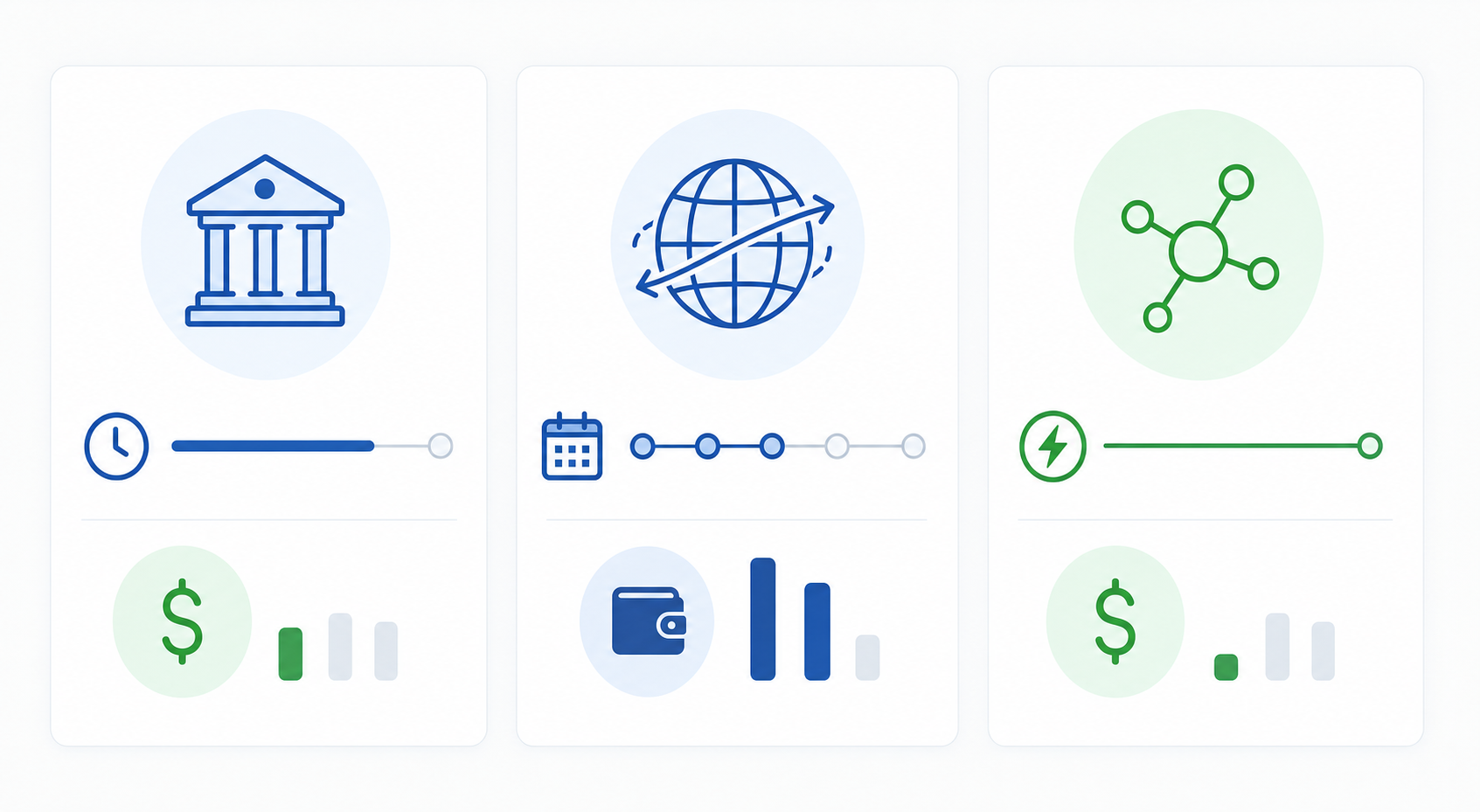
International wire transfers sent via SWIFT (Society for Worldwide Interbank Financial Telecommunication) carry sender fees of $25 to $65 per transfer at most US banks. Senders also face correspondent bank charges deducted from the transfer amount in transit, typically $10 to $30 per intermediary bank, meaning the recipient receives less than the amount sent. On a $1,000 transfer routed through two correspondent banks, the payee might net $940 or less after all deductions clear. For high-volume payout operations, those per-transfer deductions compound quickly; routing through local rails like ACH, PIX, or UPI eliminates most of this overhead on supported corridors.
How Dots Supports Businesses Sending High-Volume Remittance Payouts
Scaling global payouts breaks manual workflows. Our API moves $3bn+ to 1 million payees under one contract:
- Routes funds across 190+ countries using RTP (real-time payments), FedNow, ACH, SWIFT, PIX, UPI, Venmo, CashApp, stablecoins, and 300+ local rails.
- Verifies payee identity via KYC (Know Your Customer) and KYB (Know Your Business) checks before funds move.
- Generates 1099s automatically at year-end based on payment history and files tax documentation under one contract.
Final Thoughts on How Payment Remittance Works
Remittance is just a payment with context, but that context matters a lot when your accounts receivable team needs to match incoming funds to open invoices. Knowing your rails, your timelines, and your documentation keeps everything moving without surprises. Get in touch with Dots if you want a cleaner way to send and track high-volume payouts across borders.
FAQ
Is remittance advice proof of payment for matching incoming funds?
No, remittance advice is not proof of payment. It confirms only that a payer initiated a transfer, not that funds successfully cleared into your account. True verification requires checking your bank statement directly, since transfers can fail mid-transit due to incorrect routing details, and a physical remittance advice check can go missing in the mail.
How long does a remittance payment take compared to a standard bank transfer?
Domestic bank transfers typically clear in under 24 hours, while international SWIFT transfers settle in 1 to 5 business days, with slow corridors taking up to three weeks due to intermediary bank holds, currency conversion, and local processing rules. The underlying rail and geography determine the timeline, not the remittance itself.
What is the difference between remittance advice and an invoice?
An invoice requests payment, while remittance advice confirms which specific invoice a payer has settled. Remittance advice travels with or after the funds transfer and carries the payment remittance information your accounts receivable team needs to clear open balances without manual follow-up.
What's the fastest way to send high-volume cross-border remittance payments without per-transfer SWIFT fees eating into payouts?
SWIFT fees run $25 to $65 per transfer at most US banks, plus correspondent bank deductions, making it a poor fit for high-volume, lower-value payouts. APIs like Dots route payments across 300+ local rails, including RTP, FedNow, PIX, and UPI, with jurisdiction-aware routing that selects the lowest-cost rail per recipient automatically, avoiding SWIFT fees on corridors where faster local options exist.
What is a remittance destination, and is it the same as a billing location?
A remittance destination is the location where a buyer routes payment, either a mailing location for checks or a dedicated accounts receivable inbox for electronic payment notifications, and it is not the same as a billing location. Your billing location identifies where invoices are sent; your remittance destination tells payers exactly where to send funds, and mixing the two is a common cause of misdirected payments.