Paying Freelancers: Is it Better to Pay in Local Currency or USD?

The modern startup’s blueprint for success relies heavily on accessing world-class talent, often hiring engineers, designers, and marketers beyond US borders. For business owners, managing this global workforce makes overseas payments a hard problem to solve.
When payouts are slow or riddled with hidden fees, it causes a headache for your contractor: it erodes trust and becomes a major risk to talent retention. The payment experience is a financial function and a core part of your talent strategy.
TL;DR
- Local currency payouts with an upfront rate let contractors receive the exact amount invoiced.
- USD payouts push conversion markups and intermediary bank fees onto the contractor.
- Most freelancers get paid late at least some of the time, so payment reliability drives retention.
- A payout API that routes through local rails cuts wire fees and delivers payouts in near real time.
What Currency Is Better to Pay In?
Have you experienced getting paid in US dollars only to receive a much lower amount in your local currency after conversion and transfer fees?
The true cost of paying a contractor in US dollars, only for them to receive less than expected after international wire transfer fees and conversion markups take their share, can quickly sour any good working relationship. International freelancers are increasingly demanding transparency and reliability in how they get paid.
Factor | Pay in USD | Pay in Local Currency |
|---|---|---|
Who absorbs conversion costs | The contractor, through bank conversion markups | The payer, at an upfront transparent rate |
Amount received | Often less than invoiced after deductions | The exact expected amount |
Payment route | International wire through intermediary banks | Domestic payment rails |
Best fit | Contractors in high-inflation markets who want dollar savings | Most contractors paying local bills |
Research shows how much the payment experience shapes contractor loyalty. Remote's 2025 Contractor Management Report found that 85% of freelancers have invoices paid late at least some of the time, and just over 21% are paid late or not at all more than half the time. This is key to retention: providing certainty that the amount invoiced is the exact amount received.
The optimal strategy puts the power in the contractor's hands. By offering the choice of receiving payment in their local currency, with a transparent conversion rate upfront, business owners confirm the full expected value arrives without surprise deductions. This simple feature turns a potentially frustrating financial transaction into a positive, respectful experience.

How Do Modern Payment APIs Build Contractor Trust?
Beyond knowing the answer to is it better to pay in local currency or USD, the real goal is optimizing the payment experience itself. The key is simply adopting a modern payment infrastructure that connects directly to local bank systems across the globe.
When a payout provider uses these domestic systems, the entire process changes. A traditional wire transfer (the kind that takes days and bounces across multiple banks) becomes a near-instant transaction.
This setup bypasses the expensive and opaque conventional network, with payment delivered reliably from end to end. Instead of one wire hopping through two or three correspondent banks, the payout provider funds a local account in your contractor's country and pays out over that country's domestic system. Examples include SEPA (Single Euro Payments Area) transfers in Europe, UPI (Unified Payments Interface) in India, and PIX in Brazil. By making the payment process fast and immediate, you give contractors instant access to their money, which builds trust.
Picture a $2,000 USD invoice. If your contractor's bank applies a 3% conversion markup, that is $60, and an intermediary bank deducts $25, the invoice lands as $1,915 in local value. Paid in local currency at an upfront rate instead, the full $2,000 equivalent arrives in your contractor's account.
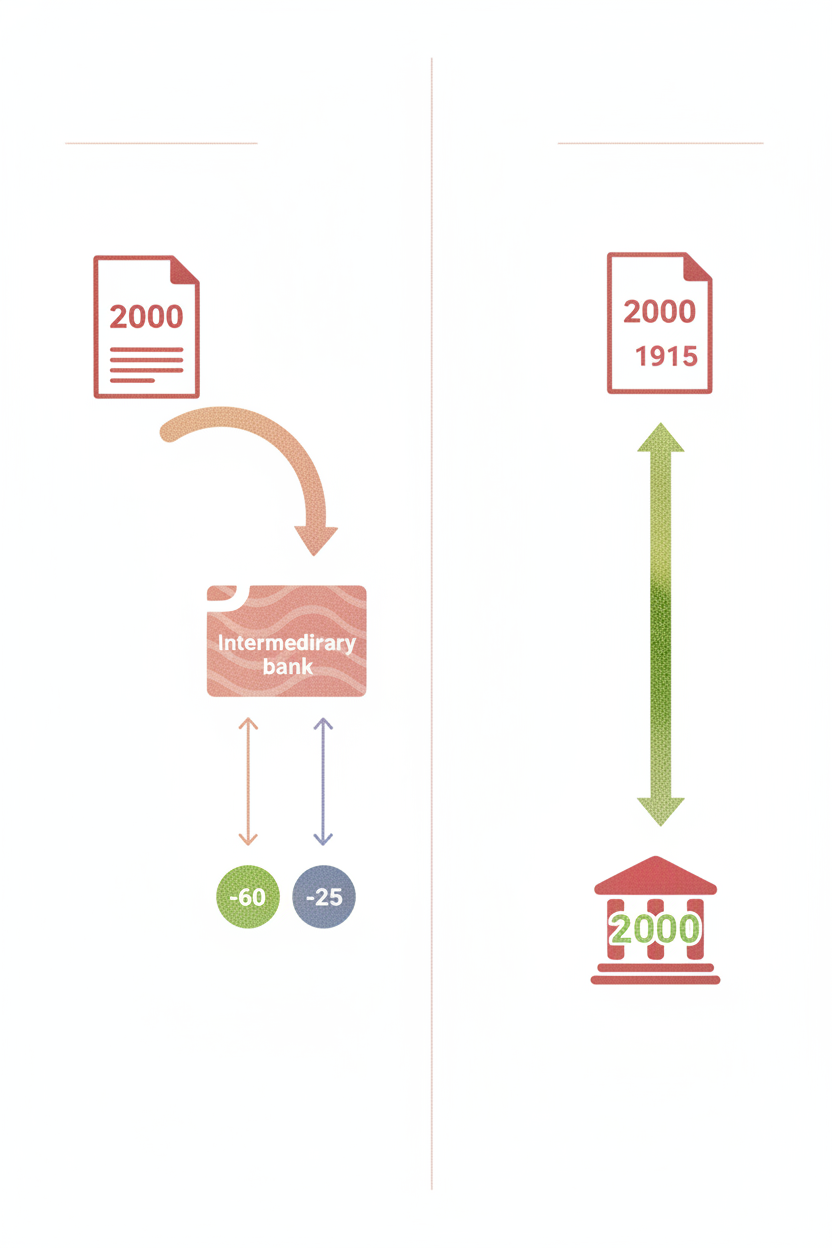
A payout API builds that kind of trust in a few clear ways:
- Shows the exchange rate before the payout is sent, so there are no surprises.
- Routes funds over local rails in your contractor's country for faster delivery.
- Sends status updates so your contractor can track each payout in real time.
- Keeps a timestamped record of every payout for both you and your contractor.
What Has Changed for Cross-Border Contractor Payouts in 2026
Dollar-pegged stablecoins such as USDC (USD Coin) are now a payout option many international contractors ask for. The GENIUS Act became law on July 18, 2025, and set federal rules for US payment stablecoin issuers. The Treasury Department published its proposed implementing rule on August 18, 2026, with comments due by October 19, 2026, so a final rule is the next milestone to watch. Read Treasury's proposed GENIUS Act rule for the full text.
Dots supports stablecoin-based payment corridors as an alternative to SWIFT (Society for Worldwide Interbank Financial Telecommunication) transfers, alongside local currency payouts. A simple decision rule works well for most business owners: if a contractor lives in a high-inflation market, offer USD or a stablecoin; otherwise default to local currency. Capture each contractor's preference during onboarding and store it on their payout profile, so every later payment follows the same choice without a manual check. Revisit the setting once a year, since a contractor's needs can change when they relocate or their local currency stabilizes.
How Do You Know if You’re with a Reliable Payments API Partner?
Secure, fast, and contractor-centric global payouts require moving beyond legacy banking systems. This strategy requires an API-first solution built to handle currency conversion transparently and automatically tap into the fastest local payment rails.
For businesses dealing with global compliance and the fierce competition for talent, a modern global payouts provider is a strategic tool, not a line item. Every new country brings its own identity checks, tax forms, and screening rules. A capable provider runs KYC (Know Your Customer) checks and collects W-8BEN forms (foreign status certification forms) from non-US contractors before the first payout clears. Handling these steps in one flow saves your team from chasing documents by email across a dozen time zones.
Dots is built to cut out the high fees, hidden markups, and friction of traditional cross-border methods. As a payout API, Dots covers payouts, onboarding, compliance, and tax under one contract. To confirm you're working with a reliable payments API, check for:
- Local Payment Rails Integration: Bypasses the slow conventional network to deliver payments instantly or near-instantly, strengthening contractor trust through speed.
- Transparent Currency Conversion: Offers contractors the choice to be paid in their local currency with upfront, guaranteed exchange rates, eliminating surprise bank fees on their end.
- API-First Security: Automates pre-payout validation and verification, reducing the manual input errors and fraud risks inherent in legacy systems.
- Lower Transaction Costs: Routing through local networks cuts high wire fees and intermediary bank charges, protecting your startup's bottom line.
With these features in place worldwide, Dots lowers your payout costs and gives your contractors the choice of secure payment in their local currency, delivering the full expected value every time. This focus on the contractor experience protects your bottom line and helps you keep global talent.
Ready to pay contractors in their local currency? Schedule your Dots demo today.
FAQs
What is the best way to send money to freelancers or gig workers across borders?
The best approach is a payout API that routes each payment through local rails in the recipient's own currency instead of a traditional international wire. Dots reaches 190+ countries with 300+ payout methods, giving freelancers and gig workers a fast, low-cost way to get paid in their home currency.
How do you automatically pay people who aren't employees?
Connect a payout API that collects tax forms during onboarding, such as W-9s (US tax identification forms) for US contractors and W-8BENs (foreign status certification forms) for non-US contractors. The API can then trigger payouts on a set schedule or by a direct API call, and Dots also files 1099s (US forms reporting payments to non-employees) on your behalf.
How do I pay international contractors in their local payment method?
Give each contractor the choice of their own payout method inside a recipient portal, whether that's a local bank transfer, mobile money, a digital wallet, or real-time rails like UPI in India and PIX in Brazil. Letting the contractor choose removes guesswork about which method actually works in their country.
How do I pay data annotators or creators in other countries?
Onboard each person with a KYC (Know Your Customer) identity check and a W-8BEN, then send batch payouts in local currency through one integration. This keeps compliance consistent across large groups of international annotators or creators while still paying them in the currency they prefer.
Can I fund payouts from a local currency account instead of converting from USD?
Many businesses hold funds in USD and convert at payout time, while others with a local entity want to pay from a local account, for example INR in India. Ask your payout provider which funding currencies it accepts and whether it can pay out without a USD conversion step. Every extra conversion adds a markup, so cutting out that step keeps more value with the contractor.