What Is KYB and How Does It Relate to KYC? (November 2026)
The Ultimate Guide to Know Your Business (KYB) and How it Relates to Know Your Customer (KYC)
Companies like yours can provide service, receive payments, send payouts, and more to consumers and corporate clients domestically and worldwide, but that reach has also created an ever-rising threat of fraud. The 2026 AFP payments fraud survey from the Association for Financial Professionals (AFP) found that 76 percent of U.S. organizations experienced attempted or actual payments fraud in 2025. It's more important than ever for businesses to take action and protect the bottom line.
Many regulatory requirements exist to help mitigate fraud issues. Know Your Customer (KYC) requirements are one of the most well-known. However, KYC is only one of many due diligence requirements companies must meet. Know Your Business (KYB) measures can reduce the risk of fraud while building trust among corporate partners or clients.
In this guide, you'll learn more about KYB verification and its importance in protecting your business. We'll also cover how it relates to KYC and contributes to your larger fraud mitigation strategies.
TLDR:
- KYB verifies corporate entities and their beneficial owners; KYC verifies individuals.
- KYB checks cover registration, ownership structure, sanctions screening, PEP lists, and regulatory compliance.
- 76% of U.S. organizations faced attempted or actual payments fraud in 2025, per the AFP.
- The 2025 FinCEN BOI rollback did not remove KYB duties for financial institutions and payout providers.
- Dots automates identity collection, sanctions screening, and fraud checks during payee onboarding.
Why Business Identity Verification Matters
KYB procedures are all about business identification. But why does that matter for companies doing business today? Shell companies and front businesses can open accounts and receive payments under a name that looks legitimate on the surface, hiding the people who actually control the money. Verifying the entity itself, and the individuals behind it, is the first line of defense against that kind of scheme.
Business verification is a practice that's most commonly associated with financial institutions. By law, banks and the businesses that work with them must perform KYB checks to assess the level of financial risk associated with a company.
While most associate fraudulent activity with bad actors, cybercriminals, and lone-wolf fraudsters, criminals can also disguise themselves as companies to defraud businesses. Business identification closes once-exploited loopholes, putting corporations under the magnifying glass. This form of due diligence allows companies to assess risks and determine if they're forming partnerships with legal and legitimate companies.
Processes help to verify the identity of individuals associated with the company, including stakeholders, Ultimate Beneficial Owners (UBOs), and other people who hold real control over the company (called PSCs in some jurisdictions). Identification procedures can also unveil more information about corporate structure, regulatory status, business activities, etc.
All this information helps corporations protect the bottom line and avoid putting themselves at risk or doing business with potential criminals. Under FinCEN's customer due diligence rule, covered financial institutions must identify and verify any individual who owns 25 percent or more of a legal entity, plus one individual who controls it. It's a critical piece of the compliance and risk management puzzle, building trust and improving safety.
Understanding Know Your Business
Know Your Business (KYB) is a verification procedure that helps companies avoid doing business with criminals while reducing the risk of fraud. It's one of many due diligence requirements that companies must perform before forming partnerships or processing transactions with another business. Legally, banks, fintech companies, and other financial institutions must verify the legal status of business clients to comply with anti-money laundering (AML) regulations. It's important to consult legal experts to understand your company's unique regulatory requirements.
Like KYC verification, KYB checks trace back to the Bank Secrecy Act (BSA), enacted in 1970 to help U.S. government agencies detect and prevent money laundering activity from drug traffickers. The U.S. Patriot Act of 2001 expanded anti-money laundering rules to counter terrorist financing. KYB-specific beneficial ownership requirements came later, added in 2016, as covered further in this post.
KYB verification fixed a loophole with traditional KYC regulations that some criminals exploited. Because businesses didn't get the same due diligence as individual customers, criminals and terrorists could use shell companies to hide their identities and commit crimes under the guise of legitimate business activity. Introducing KYB processes tightened regulations and due diligence, putting every business and individual under the same scrutiny.
KYB processes have three primary objectives:
• Identify Beneficial Owners: Identifying the individuals who own or control a business is a big part of KYB checks. KYB procedures unveil who owns or controls a business companies want to engage with, allowing them to assess the risk of fraud, money laundering, and corruption.
• Assess Compliance with Current Regulations: Due diligence requirements keep business transactions transparent, keeping all parties safe. Federal law requires regulatory compliance with frameworks like AML requirements and the Patriot Act. KYB processes confirm that potential corporate partners fully comply with the law.
• Verify Business Legitimacy: Companies must verify that businesses are legitimate and legal. KYB checks look into corporate structures, legal existence, active status, and more to avoid inadvertently engaging in illegal activity.
The Relationship between KYB and KYC
Know Your Customer (KYC) regulations are widespread. Many companies build KYC verification in banking and payouts into customer onboarding processes while performing additional verification procedures throughout the business relationship with an individual customer. KYC requirements are about identification verification. By gathering personally identifiable information, companies can verify the identity of individuals they serve or do business with, helping to prevent fraud, money laundering, terrorist financing, and more.
Know Your Business (KYB) regulations do much of the same thing, achieving the same goals. However, the differences lie in what companies must focus on when performing due diligence. KYC checks cover individuals. Meanwhile, KYB checks cover corporate customers, clients, or partners.
Some refer to KYB as "Corporate KYC," and that's a great way to look at it. The two processes are similar, and KYB has elements of KYC embedded in it. Like KYC verification, businesses typically perform KYB procedures when onboarding new corporate clients/partners. Full KYB compliance can be more complex due to the many factors and individuals involved, so consult legal experts on your requirements, but proper KYB processes still make a big difference in protecting your company.
How KYB Verification Works in Practice
KYB Processes and Protocols
Due diligence helps you avoid doing business with financial criminals while assessing potential risks. KYB procedures take time. It's a complex and delicate task, but completing the process keeps you compliant and strengthens business relationships. Because every business is different, KYB processes can vary based on the unique corporate entity and its distinct characteristics.
That said, there are several best practices and core components.
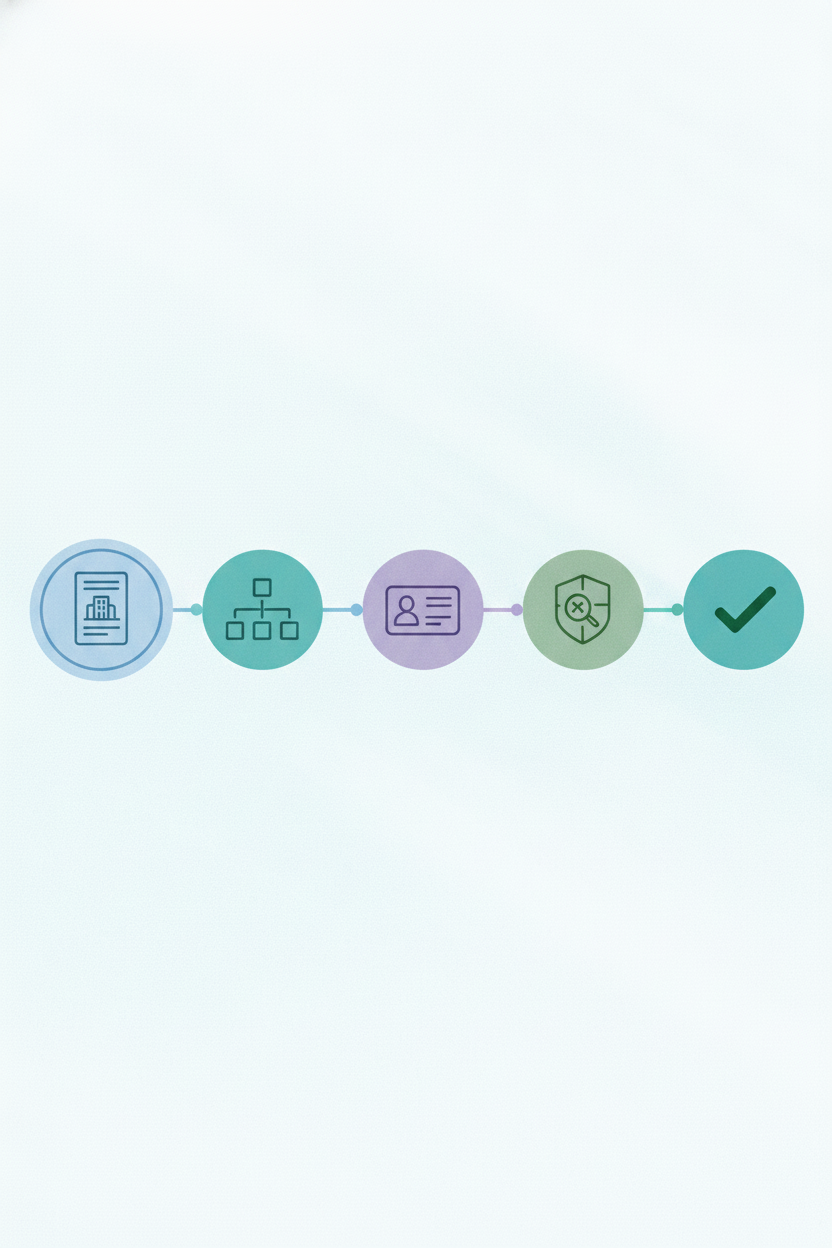
• Verification of Company Registration and Legal Existence: The first step in KYB verification is to review a company's registration and license. It involves gathering basic information about the business, including its name, registration number, entity type, etc.
• Assessment of Ownership Structure: KYB checks should also include an overall assessment of the company's ownership structure. It's important to understand who owns and controls the company.
• Identification of Beneficial Owners: KYB procedures involve digging deeper into the identities of beneficial owners. Businesses should verify identities, perform background checks, and look for potentially criminal or fraudulent activity.
• Assessment of Regulatory Compliance: Before conducting business with a corporate customer or partner, confirm the company meets all relevant regulatory requirements. That includes federal, state, and industry-specific requirements.
• Evaluation of Business Activities: Understanding business activities provides more insight into what a corporation does. This part of KYB should cover the company's products, services, customer location, areas of operation, etc.
• Blacklist Checks: Always run a list of beneficial owners through real-time OFAC and watchlist screening. Blacklists identify individuals involved in illegal activities.
• Investigation of PEP and Adverse Media: Politically exposed persons (PEPs) may be more susceptible to fraud, corruption, blackmail, and more. Working with companies involved with PEPs could increase your company's risks.
Compliance with Global and Local Regulations
In the United States, the Bank Secrecy Act (BSA) governs both KYC and KYB requirements, and the U.S. Patriot Act expanded its scope in 2001. In 2016, further changes occurred to include KYB procedures, requiring businesses to identify and verify beneficial owners involved with a legal entity.
KYB requirements vary by industry, and it's important to consult with regulators and attorneys to understand what your business must do to stay compliant. Financial institutions and companies in compliance-heavy industries have strict regulatory requirements. Missing required KYB checks can expose a covered financial institution to regulatory penalties and, in serious cases, enforcement action under the Bank Secrecy Act. Noncompliance also often triggers additional regulatory scrutiny, exposing your business to audits, surveillance, and more.
Globally, KYB requirements vary by jurisdiction. The rules and regulations of the United States are different from those of other countries. Fortunately, most operate within a framework set by the Financial Action Task Force (FATF). This framework sets broad international standards, pushing a global effort to fight financial crimes.
What Changed for KYB in 2025 and 2026
On March 21, 2025, FinCEN (Financial Crimes Enforcement Network) issued an interim final rule exempting U.S.-created companies from beneficial ownership information (BOI) reporting under the Corporate Transparency Act. FinCEN later made those exemptions permanent with a final rule, narrowing BOI reporting duties mostly to foreign entities registered to do business in the U.S. See the FinCEN beneficial ownership guidance for the current scope.
That rollback does not remove KYB duties for financial institutions and payout providers. FinCEN's 2016 customer due diligence rule still requires covered financial institutions to collect a legal entity customer's beneficial ownership information at account opening. If your business onboards corporate payees through a bank or payout provider, you still need KYB checks before that relationship can begin.
Necessity for Businesses to Meet These Standards
Businesses must meet KYB standards for several reasons. The first is regulatory compliance. The United States government takes financial crimes and money laundering schemes seriously. They are serious issues that the government works hard to prevent. The same applies to other jurisdictions around the world.
For compliance-heavy industries, regulatory compliance isn't optional. Covered financial institutions that skip required KYB checks can face Bank Secrecy Act civil penalties and enforcement actions, along with reputational damage that can outlast the fine. It's not something you want to risk.
KYB verification protects your business. Even companies outside compliance-heavy industries can benefit from performing KYB checks, since 76 percent of U.S. organizations faced attempted or actual payments fraud in 2025, per the 2026 AFP payments fraud survey cited above. KYB processes play a role in fraud mitigation, helping your company avoid falling victim to criminal activity or inadvertently contributing to it. Taking the time to perform your due diligence reduces your company's risks and keeps it out of trouble.
Finally, businesses can use KYB checks to build trust. Performing these necessary procedures shows potential partners and corporate clients that your company commits to legal, safe, and reliable operation. It's a great way to forge strong business relationships, offering peace of mind for all parties.
What Are the Differences?
KYC and KYB are two sides of the same coin. Both procedures protect your business but focus on two types of business relationships your company will form. The real differences show up in the scope and depth of the checks, as described below.
During KYC checks, your main priority is to gather personally identifiable information that allows you to screen for sanctions, identify PEPs, monitor transactions for suspicious activity, and conduct thorough risk assessments. You're putting individuals under a magnifying glass to confirm they're not involved with criminal activity.
KYB checks are more expansive. You're looking at individuals and also assessing the organization as a whole. During KYB verification, you must look into the company to confirm it's not a shell corporation. You must learn about the company's structure and assess business activity before turning to the beneficial owners.
Business verification includes many of the same due diligence tasks as KYC processes, allowing you to learn more about stakeholders and owners. However, it adds a review of the corporation's activity and regulatory compliance.
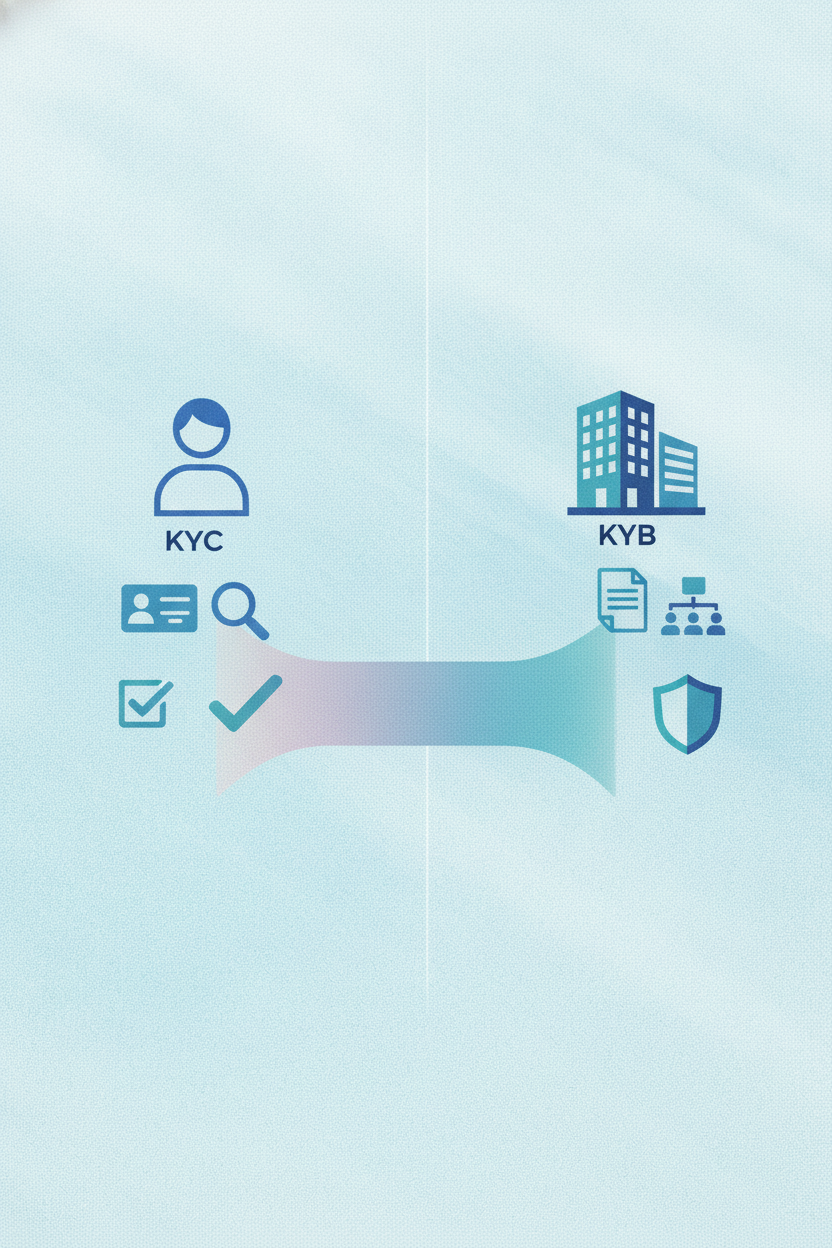
Factor | KYC | KYB |
|---|---|---|
Who is verified | Individual customers | Corporate customers, partners, and their beneficial owners |
Main data collected | Personally identifiable information | Registration, license, entity type, ownership structure, UBO identities |
Core checks | Sanctions, PEP screening, transaction monitoring | All KYC checks plus legal existence, business activities, regulatory compliance |
Main risk targeted | Identity fraud and money laundering by individuals | Shell companies and hidden owners |
U.S. legal basis | Bank Secrecy Act and USA PATRIOT Act | Same, plus 2016 beneficial ownership rules |
What Are the Benefits?
We can't understate the benefits of KYB procedures. The biggest advantage of due diligence is gaining a deeper understanding of the company you're working with. Fraud is a serious issue that plagues businesses worldwide. Financial crimes are widespread, and it's easier to fall victim to criminals than most realize.
KYB processes cut your company's risk of fraud. You can stay up-to-date on your risks, analyze factors that make your company vulnerable, and vet every potential business partnership. Risk assessment matters, and KYB procedures surface all the possible issues with partners and corporate customers.
Implementation in Various Industries
All industries can benefit from extra vetting and due diligence. However, you will most likely see KYB procedures in compliance-heavy industries like finance, law, insurance, health care, etc.
In banking, KYB processes play a massive role in assessing the risk of providing business loans, payment support, and other financial services. The same applies to fintech companies. E-commerce companies can use KYB checks to confirm legitimate business operations and support instant vendor onboarding and verification, whether partnering with small retailers or suppliers. Meanwhile, insurance companies can use the information they uncover to understand corporate policyholders and their risks.
Evolving Technologies in Business Identity Verification
Regulatory requirements like KYB are notorious for being complex, resource-intensive, and time-consuming. However, newer technologies are flipping the script, making meeting due diligence requirements easier.
Automation and artificial intelligence are paving the way to faster processes. Dots automates the collection of digital identification information, running data through sanction lists and verification checks without manual input. Results arrive in real time for fast decision-making. These tools save time and money while giving businesses faster workflows and better onboarding.
Get Started With Dots Today
KYB procedures are important for businesses today. The risk of fraud is everywhere, and failing to do your due diligence can put your business in the crosshairs. KYB regulatory requirements exist to protect companies like yours. They mitigate your risks while playing a larger role in reducing financial crimes worldwide.
When you want to improve your company's approach to risk mitigation, turn to Dots. Dots is global payout infrastructure delivered as a developer-friendly API that lets you send payments to corporate clients, suppliers, freelancers, and more. Our API has several powerful tools to safeguard your business. Take advantage of KYC features, built-in security tools for AML, BSA, and OFAC (Office of Foreign Assets Control) compliance.
Algorithmic fraud detection and identity verification round out the toolkit. Dots gives your company a clearer approach to risk mitigation and fraud prevention, making it easier to do your due diligence.
Schedule your Dots demo to learn more.
FAQs
What is the difference between KYB and KYC?
KYC (Know Your Customer) verifies the identity of individual customers, while KYB (Know Your Business) verifies the corporate entities a company works with, including their beneficial owners and legal structure. Some call KYB "Corporate KYC" because the two processes share due diligence steps but apply to different parties.
Which businesses are required to perform KYB checks?
Banks, fintech companies, and other financial institutions must perform KYB checks on corporate clients to comply with anti-money laundering (AML) regulations under the Bank Secrecy Act and the U.S. Patriot Act. Companies in compliance-heavy industries like insurance and health care also commonly apply KYB procedures when onboarding corporate partners.
What information is collected during KYB verification?
KYB verification gathers company registration details, ownership structure, and the identities of beneficial owners and other people who hold real control over the company. It also covers regulatory compliance status, business activities, and checks against sanction lists and adverse media for politically exposed persons (PEPs).
Do the 2025 FinCEN beneficial ownership changes end KYB requirements?
No. U.S. companies no longer file BOI reports with FinCEN, but financial institutions still collect beneficial ownership information at account opening under the 2016 customer due diligence (CDD) rule. KYB due diligence remains a requirement for banks and other supervised companies forming new corporate relationships.
How does Dots handle KYC and identity verification for payees?
Dots Onboard collects payee details as part of the onboarding process, and the Dots API includes KYC features, identity verification, AML, BSA, and OFAC screening. Algorithmic fraud detection runs before payouts move, giving your company built-in due diligence on every payee.
What does Dots do?
Dots is global payout infrastructure delivered as a developer-friendly API, covering payouts, payee onboarding, compliance, and tax under one contract. Companies use Dots to send payments to corporate clients, suppliers, freelancers, and more while meeting regulatory requirements.
What payout methods does Dots support for verified payees?
Once payees clear onboarding checks, Dots routes funds through RTP (Real-Time Payments), FedNow, ACH, Venmo, CashApp, SWIFT, and 300+ local rails across 190+ countries, and payees pick the method that works best for them. Real-time rails carry no extra instant surcharge, so verified payees get fast access to funds without paying more for speed.