W9 vs 1099 Form: Key Updates for Small Businesses October 2026

If you've ever paid a contractor without collecting their tax identification number, you know the scramble that follows. The w9 vs 1099 form question trips up even experienced business owners because these documents serve completely different purposes at opposite ends of your payment cycle. Our position: treat the W-9 as a hard gate before the first contractor payout, and treat the 1099 as the year-end report that gate makes possible. Getting the timing right, requesting a W-9 during onboarding and filing a 1099 after the tax year closes, is the difference between smooth compliance and expensive penalties.
TL;DR:
- W-9 forms collect tax details before you pay contractors; 1099s report yearly earnings to the IRS
- File 1099-NEC forms by January 31, 2026 to avoid IRS penalties starting at $60 per form
- The 1099-NEC reporting threshold rises from $600 to $2,000 for 2026 payments; payments made in 2025 still use the $600 threshold and are reported by January 31, 2026
- Mismatched names or missing Social Security Numbers trigger mandatory 24% backup withholding
- Dots automates W-9 collection and 1099 filing so you never chase paperwork or miss deadlines
What Is a W-9 Form and Who Needs to Fill One Out
Before paying a new freelancer, you need their tax details. The w9 form acts as the official request for a taxpayer identification number (TIN) and certification. You use it to gather exact legal names, mailing details, and Social Security Numbers directly from non-employees, which makes it the very first step in your contractor onboarding workflow. This guide focuses on contractor payments, but per IRS guidance, businesses and individuals also use Form W-9 for real estate sales, mortgage interest paid, cancellation of debt, and IRA contributions.
Who completes the paperwork
The core difference between a contractor and an employee is control. Contractors decide when and how they complete the work and handle their own taxes, while employers handle withholding for employees. Picture a freelance graphic designer who sets their own hours and invoices per project, next to a salaried in-house designer: the freelancer completes a W-9 and later receives a 1099-NEC, while the employee receives a W-2 (the year-end wage statement) instead.
Any domestic gig worker expecting to earn more than $600 in a calendar year must complete a W-9 before you send payment. This includes freelancers, independent contractors, consultants, and sole proprietors. The IRS is changing that $600 reporting threshold to $2,000 for payments made in 2026, though collecting a W-9 upfront remains the safest habit. Foreign contractors working outside the United States complete a W-8 series form instead.
Keep each contractor's completed W-9 on file for at least four years, a safe window under IRS recordkeeping guidance, in case of IRS inquiries or disputes with the worker. You never submit the form to the IRS, but having it on file proves you collected the tax details before paying.
What Is a 1099 Form and When Must You Issue One
After collecting a payee's initial tax details, keep them safe until tax season. An IRS 1099 form acts as the official year-end record of payments made to outside workers. You file this document with the Internal Revenue Service and send a copy to the payee.
Understanding the 1099-NEC form
For most freelancers, you will use the 1099-NEC, though payments such as rent, royalties, or prizes and awards require filing Form 1099-MISC instead. The 1099-NEC reports nonemployee compensation, which means payments to contractors for services they performed for your business. Form 1099-MISC covers those other payment types because they are not payments for services. Choose the form based on the type of payment, not the type of worker.
W-9 vs 1099: Understanding the Core Differences
Think of these two documents as the bookends of your non-employee relationships. One starts the business arrangement, while the other closes the tax year. Understanding the w9 vs 1099 form differences keeps you compliant when working with 1099 workers.
Differences | W-9 Form | 1099 Form |
|---|---|---|
Prepared by | Payee | Payer |
Submitted to | The business (payer) | IRS, payee, and applicable states |
Used for | Collecting taxpayer ID information | Reporting annual payments |
Filed with the IRS | No, kept on file | Yes |
Threshold | None, requested at onboarding | $2,000 for 2026 payments, previously $600 |
Deadline | Before the first payment | January 31, 2026 for 1099-NEC |
When comparing the 1099 tax form vs w9, timing and destination matter most. You request initial profile details during onboarding, before transferring a single payment. The annual information return follows months later, after the calendar year closes, and gets sent to both the IRS and the payee.
Critical Deadlines for 2026: When to Collect W-9s and File 1099s
Gathering a free w-9 form 2025 should happen the moment you hire a worker. Waiting until January to track down tax numbers causes unnecessary stress. Collecting a signed w 9 form independent contractor pdf upfront keeps your reporting calm and compliant.
When 2026 arrives, strict dates apply. You must submit the 1099-NEC form to the worker and file it with the IRS by January 31, 2026. Missing this deadline triggers penalties starting at $60 per form, escalating quickly if you delay further.
The reporting threshold is changing too. Starting with 2026 payments, the IRS reporting threshold for Form 1099-NEC and 1099-MISC rises from $600 to $2,000 per contractor per year. Payments you made in 2025 still fall under the $600 threshold and appear on forms filed by January 31, 2026, while the $2,000 threshold applies to payments made during the 2026 calendar year, which you report in early 2027. Our advice: keep collecting a W-9 from every contractor on day one, because contractors often cross the $2,000 line mid-year and chasing a taxpayer identification number after that point is the exact scramble this guide helps you avoid.
Common Filing Mistakes That Trigger IRS Penalties
Small errors on a 1099 form for contractors bring steep financial penalties. The IRS fines businesses for typos and deadlines, and most penalties trace back to a short list of avoidable mistakes, from missing documentation to mismatched names and skipped state filings. Checking details early protects your bottom line.
Watch out for these five common traps:
- Paying workers before collecting documentation. Get your w 9 form independent contractor download before transferring a single dollar. If a payee disappears without providing tax details, you face mandatory backup withholding and reporting requirements.
- Issuing 1099s when an exception applies. You do not need to issue a 1099-NEC to corporations, or for payments made by credit card, debit card, or third-party payment networks like PayPal or Venmo, because those networks report the payments on Form 1099-K instead. Double-reporting these payments is a common and avoidable error.
- Filing with a name or TIN that does not match IRS records. Copy each payee's legal name and TIN (Taxpayer Identification Number) exactly as written on their W-9. A mismatch can trigger an IRS CP2100 notice, which requires 24% backup withholding on future payments to that worker until they provide corrected details.
- Using the wrong form type. Report payments for services on the 1099-NEC, and report rent, royalties, and prizes and awards on the 1099-MISC. Picking the wrong form means filing a corrected return, so match the form to the payment type before you file.
- Skipping state filing. States such as New York, Pennsylvania, and Oregon run direct-file portals, and state deadlines can differ from the federal January 31 date. Check the rules for every state where your contractors live and work, and confirm each state copy goes out with your federal filing.
How to Use W-9 and 1099 Forms Together: A Step-by-Step Workflow
Connecting onboarding to tax season requires a repeatable process. Knowing how to use the 1099 form vs w9 together prevents deadline scrambling, and understanding form 1099-K helps when payment services are involved. Here is how these documents interact.
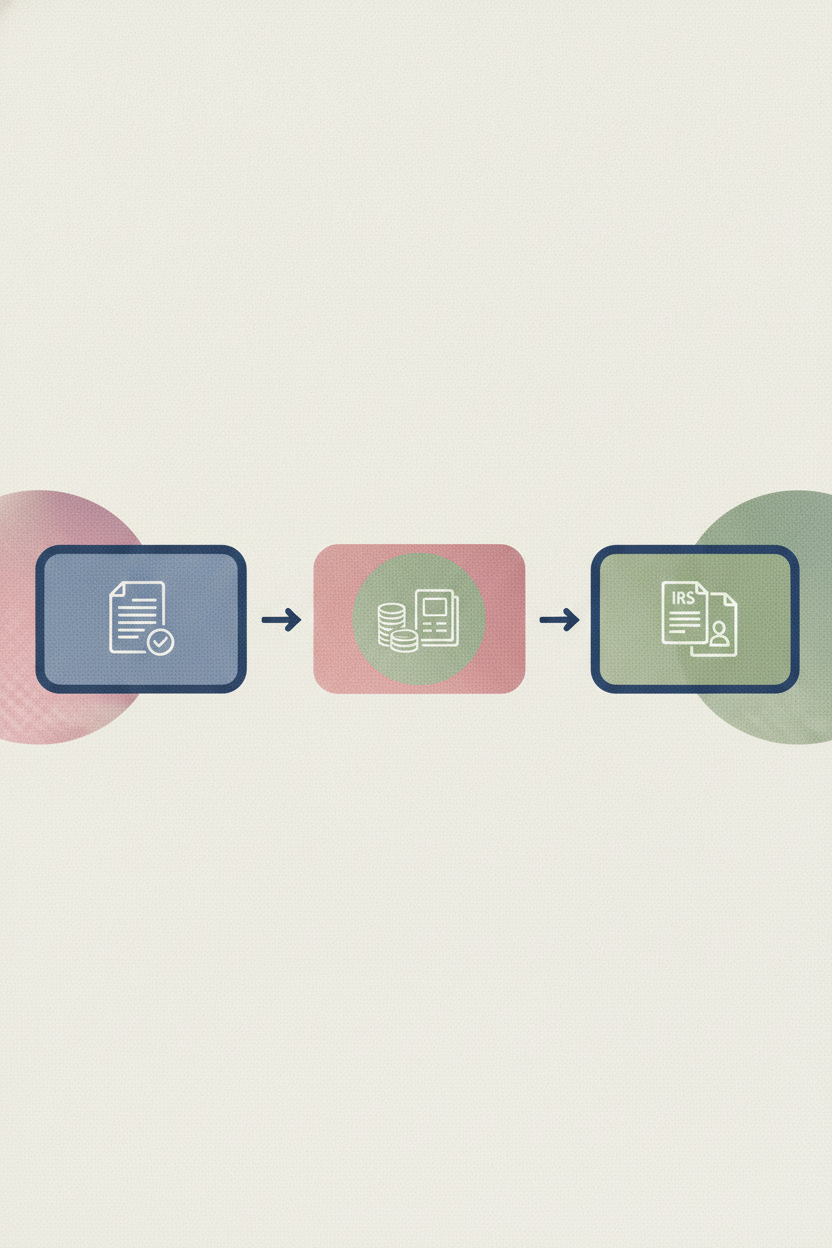
Phase | Action Required | Associated Document |
|---|---|---|
Onboarding | Request tax details before paying | w-9 form 2026 printable |
Mid-Year | Track payments to each contractor | Payment records and invoices |
Year-End | File 1099-NEC by January 31, 2026 | 1099-NEC form |
Automating Tax Compliance and Contractor Payouts with Dots
Chasing down a 1099 form for contractors to fill out takes time away from scaling your company, which is why APIs for automating 1099 tax filing are gaining traction. Dots Tax takes over the entire process from initial payee onboarding to year-end filing.
Our automated compliance and tax management setup collects required W-9 details before transferring a single payout so you never fall behind. Here is how Dots handles contractor taxes:
- Real-time Taxpayer Identification - Dots validates Social Security Numbers and Employer Identification Numbers instantly against IRS records, catching mismatches before they trigger backup withholding requirements.
- Automated 1099 Generation - Our system tracks every payment throughout the year and generates accurate 1099-NEC forms automatically, eliminating manual data entry and calculation errors.
- E-Filing with the IRS - Dots submits your 1099 forms electronically to the IRS and state agencies before the January 31 deadline, with automatic copies sent to each payee.
- Year-Round Audit Trail - Every W-9 submission, payment, and tax document is stored securely in one dashboard, ready for IRS audits or internal reviews.
Final Thoughts on Simplifying Contractor Tax Compliance
Understanding w9 vs 1099 form requirements is just the start of building a compliant contractor workflow. Requesting W-9s during onboarding and filing accurate 1099s by the deadline protects your business from penalties and payment delays. Manual tracking eats hours you could spend growing your company, so Dots brings contractor payouts, W-9 collection, and 1099 filing under one contract. Book a call with our team to automate tax compliance from onboarding through year-end filing.
FAQs
When should I collect a W-9 from a contractor?
Request the W-9 before you send the first payment to any domestic worker who will earn more than $600 in a year. Collecting tax details upfront prevents year-end scrambling and keeps you compliant.
What's the main difference between a W-9 and a 1099 form?
A W-9 collects tax identification details from contractors during onboarding, while a 1099 reports total payments made to them at year-end. You request the W-9; you file the 1099 with the IRS.
How much does the IRS fine you for missing 1099 deadlines?
Penalties range from $60 to $310 per form depending on how late you file, as listed in the IRS information return penalties schedule. Missing the January 31 deadline entirely can trigger the maximum penalty, plus backup withholding requirements on future payments.
Can I pay a contractor before receiving their W-9?
No. If a worker refuses to provide a completed W-9, you must withhold 24% of their payments for backup withholding and send that amount to the IRS. Always collect the form first.
Do I send a completed W-9 to the IRS?
No, you keep the completed W-9 on file rather than filing it with the IRS. You use the details on the form to prepare the 1099 you file after the tax year ends.
Do foreign contractors fill out a W-9?
No, contractors working outside the United States complete a W-8 series form instead of a W-9. Dots collects the right form from each payee automatically during onboarding.
How does Dots automate W-9 collection and 1099 filing?
Dots collects W-9 details automatically during payee onboarding, validates tax identification numbers in real time, and files 1099 forms electronically before the January 31 deadline - no manual tracking required.
Does an LLC get a 1099?
It depends on how the LLC is taxed. LLCs taxed as corporations are generally exempt from 1099-NEC, while single-member LLCs and partnerships typically receive one, so collect a W-9 to confirm the tax classification. Check the LLC 1099 filing requirements before you decide.