How Podcast Networks Pay Hosts and Producers Across 300+ Rails

Most hosts sign a revenue split and assume the percentage on the page is the percentage they'll see in their account. But podcast network payouts rarely work that cleanly. Ad revenue gets filtered through CPM mechanics, gross vs. net distinctions, producer waterfalls, and settlement rails that each introduce their own timing and cost. Walking through the full cycle makes it a lot easier to spot where the gap between your contract and your check actually comes from.
TLDR:
- Host revenue splits default to 70/30, but gross vs. net and recoupment clauses can drop your effective rate below 50%.
- Producers earn $200 to $500 per episode or a small net revenue cut, with payouts batched quarterly and tied to advertiser collections.
- US payees earning $600 or more must submit a W-9 before funds move; missing tax forms trigger 24% backup withholding under IRC Section 3406.
- ACH settles in 1 to 5 business days; SWIFT cross-border transfers add $25 to $65 in sender fees per payment.
- Dots routes podcast network payouts across 300+ rails to 1 million+ payees in 190+ countries, with automated W-9, W-8BEN, and 1099 filing built in.
How Podcast Networks Generate Revenue
Before anyone gets paid, money has to enter the system. Podcast networks pull revenue from several streams, though not all carry equal weight.
Advertising remains the dominant source. Networks sell inventory through direct deals with brands or through programmatic ad marketplaces, pricing spots on a CPM, CPC, and CPA creator payouts (cost per mille, or cost per thousand listens) basis. With over 619.2 million global podcast listeners as of 2026 (Backlinko), the addressable audience keeps growing, and ad budgets follow.
Beyond ads, networks generate income through:
- Brand sponsorships tied to specific shows or hosts, often structured as flat fees or hybrid CPM-plus-guarantee contracts
- Listener subscriptions and premium memberships that give audiences access to bonus episodes or ad-free feeds
- Content licensing to other distributors or media companies looking to fill their own catalogs
- Cross-promotion arrangements between shows in the network's roster, which trade audience exposure for revenue upside
The mix varies by network size and genre, but advertising typically accounts for the largest share. That matters because the total pool available for podcast network payouts to hosts, producers, and guests is shaped upstream by how a network monetizes its catalog.
The CPM Model: How Ad Revenue Is Priced and Measured
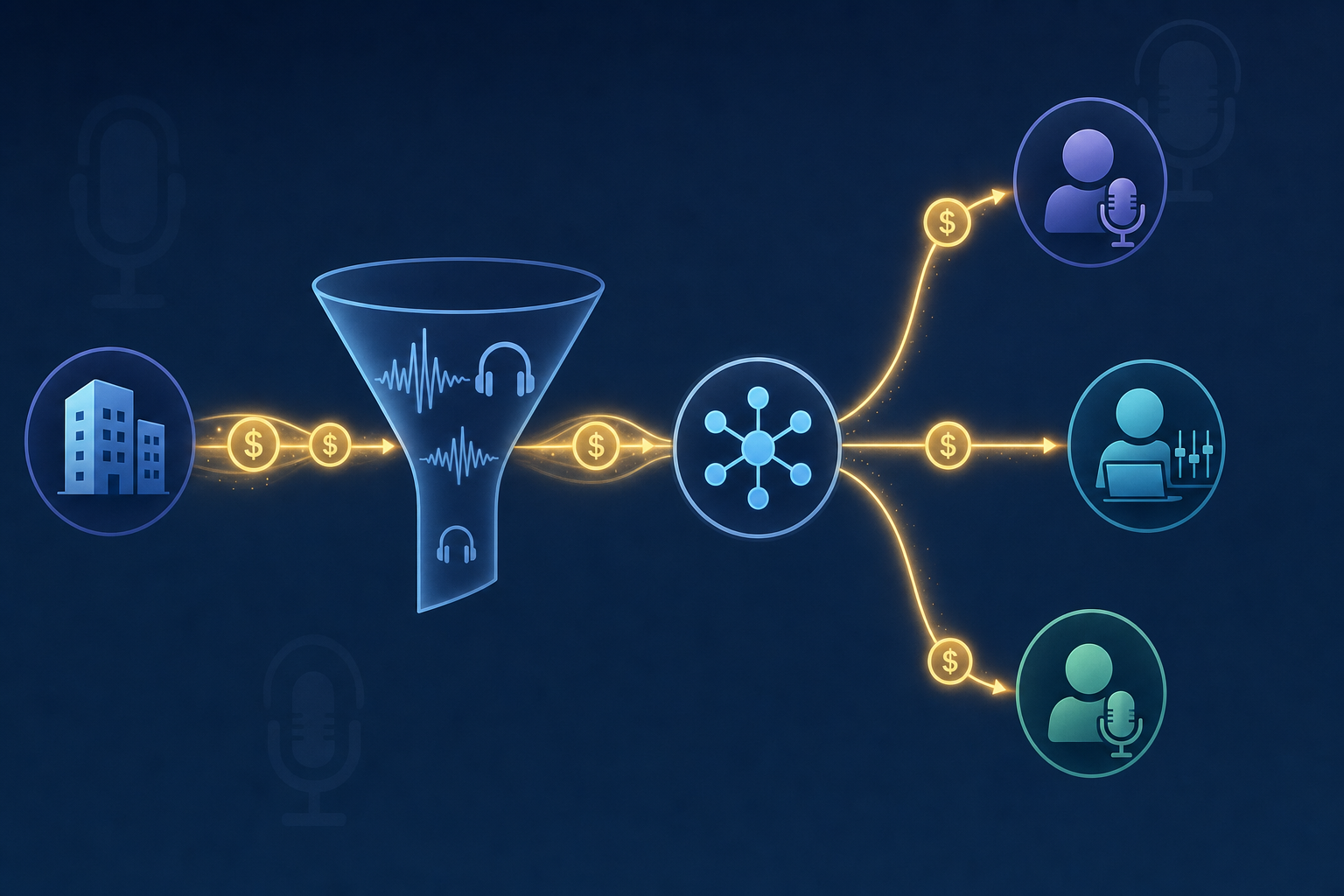
Most podcast network payouts tie directly to CPM, or cost per mille, the price an advertiser pays per 1,000 qualified listens. CPM sets the ceiling for what a network can distribute to hosts, producers, and guests after its own cut.
Rates vary by format and audience niche. A general entertainment show might command $18 to $25 CPM, while a finance or B2B podcast can pull $40 to $80 CPM because advertisers value high-intent listeners willing to spend. Host-read ads typically carry a premium over pre-produced spots because audiences trust the host's voice.
How CPM Flows Into Payouts
The path from advertiser invoice to individual payee follows a rough sequence:
- The advertiser commits to a CPM rate and a target impression count, locking in the total campaign spend before a single ad airs.
- The network verifies downloads using an IAB 2.1 compliant prefix, filtering out bots, duplicate requests, and partial streams so only qualified listens count toward the impression total.
- After confirming delivery, the network invoices the advertiser on net-30 or net-60 terms, meaning cash may not arrive for one to two months after the episode publishes.
- Once funds clear, the network applies its revenue share split and routes each payee's portion through whatever rail the contract specifies: ACH (Automated Clearing House) bank transfer, wire, or an instant option like RTP.
Understanding CPM mechanics matters because every delay or measurement discrepancy in this chain shrinks the pool available for podcast network payouts. A 10% impression shortfall on a $50 CPM campaign against 500,000 targeted downloads turns a $25,000 gross into $22,500 before the network even takes its share.
How Networks Split Ad Revenue with Hosts
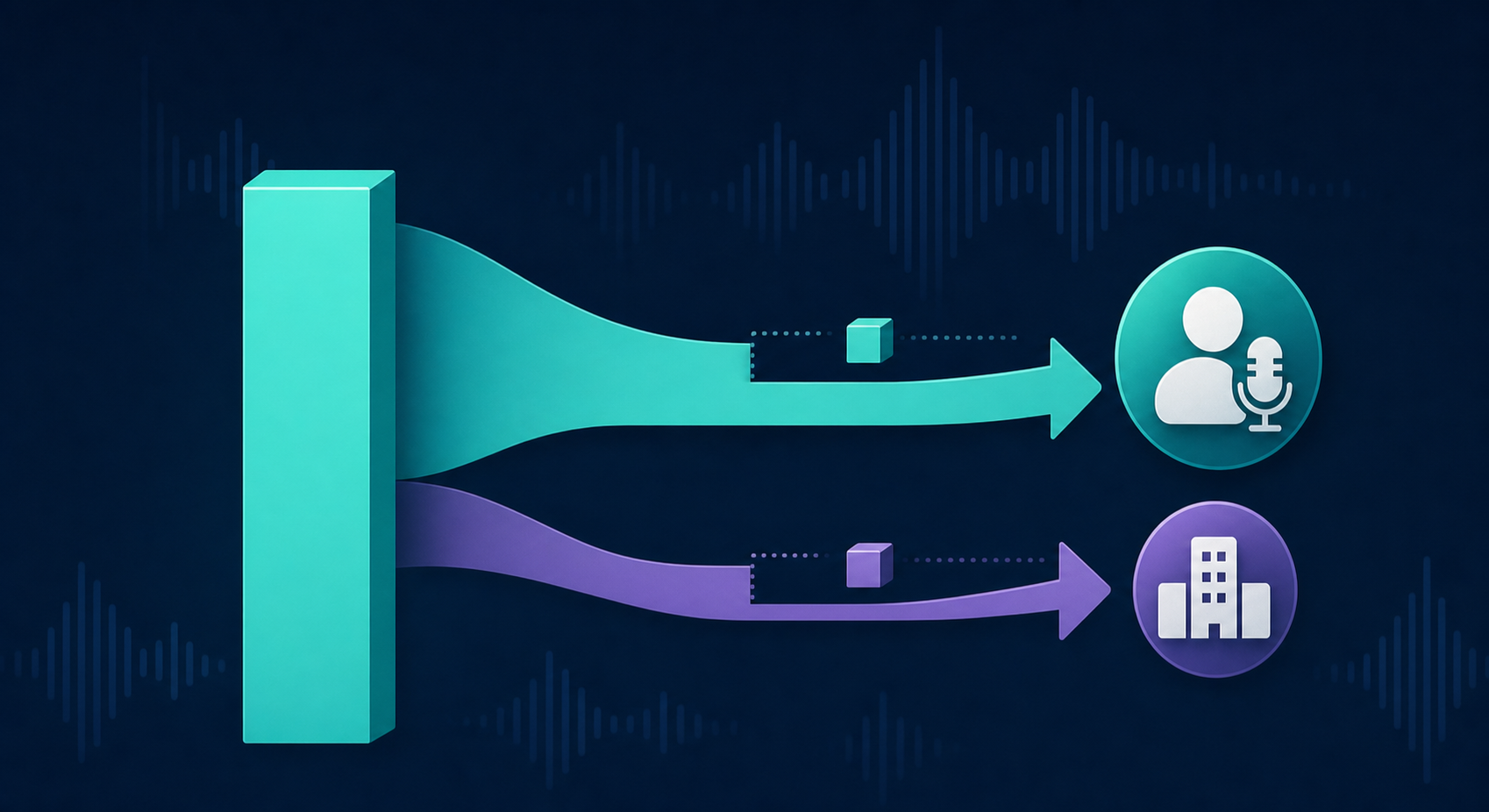
The most common baseline is a 70/30 split in favor of the host, though the number moves. Hosts with larger audiences or exclusive content can push their share to 80% or higher, while newer shows with little proven download history may accept 50/50 or worse until they build negotiating power. Kara Swisher and Scott Galloway reportedly negotiated a 70/30 deal with Vox Media for their shows, a clear example of how proven hosts with large audiences can lock in favorable terms even inside a major network.
What catches many hosts off guard is whether the split applies to gross or net revenue. A gross split means 70% of the total ad dollars collected. A net split means 70% of whatever remains after the network deducts production, marketing, and distribution costs. Recoupment clauses work similarly: if the network fronted money for launch costs or studio time, it may recover those expenses from the host's share before any payout is issued. Two contracts can both say "70/30" and produce very different checks.
How Producers Are Compensated
Producers sit below hosts in the payout waterfall, and the compensation structure reflects that gap. Most producers receive one of three arrangements: a flat per-episode fee (commonly $200 to $500 for mid-tier shows), a monthly retainer, or a small percentage of net revenue calculated after the host's share has already been applied. A producer earning 10% of net on a show that generates $15,000 in monthly ad revenue at a 70/30 host split would take home $450, since their cut comes from the network's $4,500 portion.
Nearly all producers are classified as independent contractors. That means no health insurance, no retirement match, and full responsibility for self-employment taxes, which run about 15.3% self-employment tax (IRS).
Payment timing compounds the strain. Networks often batch producer payouts on quarterly cycles tied to their own advertiser collections, so a producer who edits an episode in January may not see cash until April. When earnings reports arrive late or lack line-item detail, matching what you're owed against what landed in your account becomes its own unpaid task.
How Guests Are Paid (and When They Are Not)
Most podcast guests are never paid. The standard arrangement is an appearance-only deal covered by a guest release form, which grants the network rights to use the recording but creates no payment obligation. The guest gets exposure; the network gets content.
Cash enters the picture in a few specific cases:
- Branded podcasts sometimes pay expert guests a flat fee for their authority on a niche topic, with rates typically running $250 to $2,000 per appearance: lower-tier subject-matter experts tend to land at the $250 to $500 range, while recognized voices with large followings or high-demand niches command $1,000 to $2,000
- Affiliate commissions tied to a promo code or referral link, where the guest earns a percentage of attributed sales generated during or after the episode (see how podcast platforms pay hosts for more on these structures)
- Celebrity or high-profile bookings that command per-appearance fees negotiated before recording, often structured as a one-time disbursement with no residual share
If there is no signed payment contract or affiliate agreement, there is no payee in the system. That distinction matters for networks managing podcast network payouts at scale: guest releases and payment contracts trigger very different compliance and disbursement workflows.
Payment Timing, Payout Minimums, and Settlement Rails
Networks typically disburse on monthly or quarterly cycles, and most impose minimum payout thresholds, often $50 to $100, that hold your earnings until the balance clears the floor. If your show generates $40 in a given month, that cash sits until the next period rolls around.
The rail determines how fast funds land once released. ACH bank transfers take 1 to 5 business days to settle. PayPal and wallet-based options can move faster. For hosts outside the US, SWIFT-based transfers layer on both delay and cost, with SWIFT sender fees of $25 to $65 at standard interbank pricing. That gap between "you earned it" and "you can spend it" is a key payout speed retention metric and one of the most persistent complaints across podcast network payouts.
Rail | Settlement Time | Sender Fee (per transfer) | Best For |
|---|---|---|---|
ACH | 1 to 5 business days | Low / none | US-based hosts and producers |
RTP / FedNow | Seconds | Low / none | Instant domestic disbursements |
PayPal / Wallet | Minutes to hours | Varies | Faster domestic or cross-border payouts |
SWIFT | 2 to 5 business days | $25 to $65 | International creators (with cost drag) |
Tax Obligations for Podcast Network Payouts
Every US-based host, producer, or guest who earns $600 or more in a calendar year must submit a W-9 before the network can file a 1099-NEC on their behalf. The W-9 collects the payee's TIN (Taxpayer Identification Number), and if that TIN is missing or fails IRS matching, the network must withhold 24% of each payment as backup withholding under IRC Section 3406.
Non-US creators file a W-8BEN form instead, which certifies foreign status and can reduce the default 30% withholding on US-sourced income if a tax treaty applies.
For a network paying hundreds of creators across multiple countries, a single missing form can freeze an individual's payout while the rest of the batch moves forward. At scale, 1099 and W-8BEN collection manual collection turns into a bottleneck that compounds every payment cycle.
Contract Terms That Directly Affect Your Payout
The gross vs. net distinction covered earlier is only one line item worth reading carefully. Several other clauses quietly reshape what you take home.
- Exclusivity provisions can bar you from hosting or appearing on competing shows, cutting off side revenue that might otherwise supplement a low split
- Audit rights let you (or your accountant) inspect the network's download counts and ad invoices to verify the numbers behind your share. If the contract lacks an audit clause, you're trusting their math on faith.
- Termination clauses determine whether earned but unpaid revenue follows you out the door, a situation where pre-funding creator earnings can matter. Some contracts release accrued earnings within 60 to 90 days of exit; others tie residual payments to continued exclusivity through a post-termination window
If a contract says "70/30 net" but includes recoupment, exclusivity, and a six-month post-termination holdback, your effective rate could land well below 50%.
Read every clause against the payout it produces, not the percentage it promises.
How Dots Handles Podcast Network Payouts Across 300+ Rails
We built Dots to sit underneath all of the complexity described above. Our API moves $3bn+ to more than 1 million payees across 190+ countries, routing funds through 300+ rails: RTP (Real-Time Payments), FedNow, ACH (Automated Clearing House), Venmo, CashApp, SWIFT, and hundreds of local international options.
For podcast networks, that means a single integration covers:
- KYC (Know Your Customer) onboarding for every host, producer, and guest before funds move
- Automated W-9 and W-8BEN collection, TIN (Taxpayer Identification Number) matching, and 1099 filing at year-end based on cumulative payment history
- Real-time disbursements with no daily volume caps and no instant-payout surcharge
- A white-labeled recipient portal where payees pick their preferred rail
The timing gaps, compliance bottlenecks, and cross-border fee drag covered in earlier sections are the exact problems our payout lifecycle was designed to solve. One contract, one API call, and the money lands.
Final Thoughts on How Podcast Network Payouts Work
The gap between what a network earns and what lands in your account comes down to contract language, payment timing, and tax compliance, beyond the split percentage alone. Understanding each piece gives you real negotiating power, whether you're on your first deal or auditing your fifth. Connect with Dots if faster cross-border disbursements and automated compliance are on your radar.
FAQ
What's the fastest way to handle podcast network payouts across hundreds of hosts and producers without building custom payout rails?
The fastest path is a single API that covers onboarding, compliance, and disbursement in one contract. Dots routes payments through 300+ rails, including RTP and FedNow, with no instant-payout surcharge and no daily volume caps, so hosts and producers receive funds as soon as the network releases them, with no wait on rail-specific queues or ACH batch windows.
Can a podcast network pay international creators without the standard 30% withholding on US-sourced income?
Yes, but only if the network collects a W-8BEN before the first payout clears. The W-8BEN certifies the creator's foreign status and can apply treaty-based rates that reduce the default 30% backup withholding. Without it, the full 30% applies automatically and the network bears the compliance liability.
How do podcast network payouts work when a show's revenue split says "70/30" but includes recoupment and net-revenue language?
The percentage alone does not tell you what lands in your account. A gross 70/30 means 70% of total ad dollars collected; a net 70/30 means 70% of what remains after the network deducts production, marketing, and distribution costs. Add a recoupment clause for launch costs and a post-termination holdback, and your effective rate can fall well below 50% even when the contract reads "70/30."
How do I automate W-9 and 1099 collection for podcast hosts and producers at scale?
Collect the W-9 before any payment clears. Once cumulative payments to a US-based host or producer cross $600 in a calendar year, IRC Section 6041 requires a 1099-NEC filing. Platforms like Dots automate TIN matching against IRS records and generate 1099s at year-end based on payment history, removing the manual collection bottleneck that compounds every payment cycle when creator counts grow into the hundreds.
When should a podcast network use Dots instead of processing host payouts through ACH or SWIFT alone?
ACH takes 1 to 5 business days to settle, and SWIFT adds $25 to $65 per transfer in sender fees on top of the delay. If your network pays hosts in multiple countries, imposes quarterly payout cycles, or manages tax-form collection manually, the cost and timing gaps compound at scale. Dots replaces that fragmented setup with a single integration covering real-time rails, automated compliance, and cross-border disbursements to 190+ countries.