How to Integrate a Payout API: Guide for November 2026

Manual payment processing is a silent growth killer. As a business scales, the administrative burden of managing hundreds or thousands of individual transactions, often across different countries and currencies, becomes unsustainable.
According to Intuit's 2024 Business Solutions Survey, businesses report spending 25 hours a week on manual data entry and reconciling data between applications, based on manual data entry research. This pattern leads to avoidable errors and payment bottlenecks.
Relying on traditional banking portals or basic payment gateways often results in high transaction fees, slow processing times, and a fragmented experience for your recipients. To eliminate these inefficiencies and build a scalable financial infrastructure, modern businesses are turning to automation. This guide shows how to integrate a payout API to cut manual work and give your global workforce a smooth payment experience.
TL;DR
- A payout API automates disbursements to contractors, sellers, and freelancers, replacing CSV uploads and manual bank logins.
- Integration follows four steps: documentation review, sandbox testing, security protocols, and KYC and tax onboarding.
- 2026 changes matter: the 1099-NEC and 1099-MISC threshold rose to $2,000, and FedNow's per-transaction cap rose to $10 million.
- Dots bundles payouts, onboarding, tax, and compliance under one API and one contract.
What is a Payout API?
A payout API (Application Programming Interface) is a set of protocols that allows your software to communicate directly with a financial service provider to automate the distribution of funds. Unlike a standard payment gateway designed to collect money from customers, a payout API is purpose-built for disbursements.
It serves as the digital bridge that lets your software trigger payments to independent contractors, freelancers, or marketplace sellers without human intervention. By using a payout API, businesses can send funds en masse via various methods, such as wire transfers, ACH (Automated Clearing House) transfers, or digital wallets, while maintaining a centralized record of every transaction. This level of automation is a core requirement for businesses that need to manage complex money flows and high-volume distributions with precision.
What is Payment API Integration?
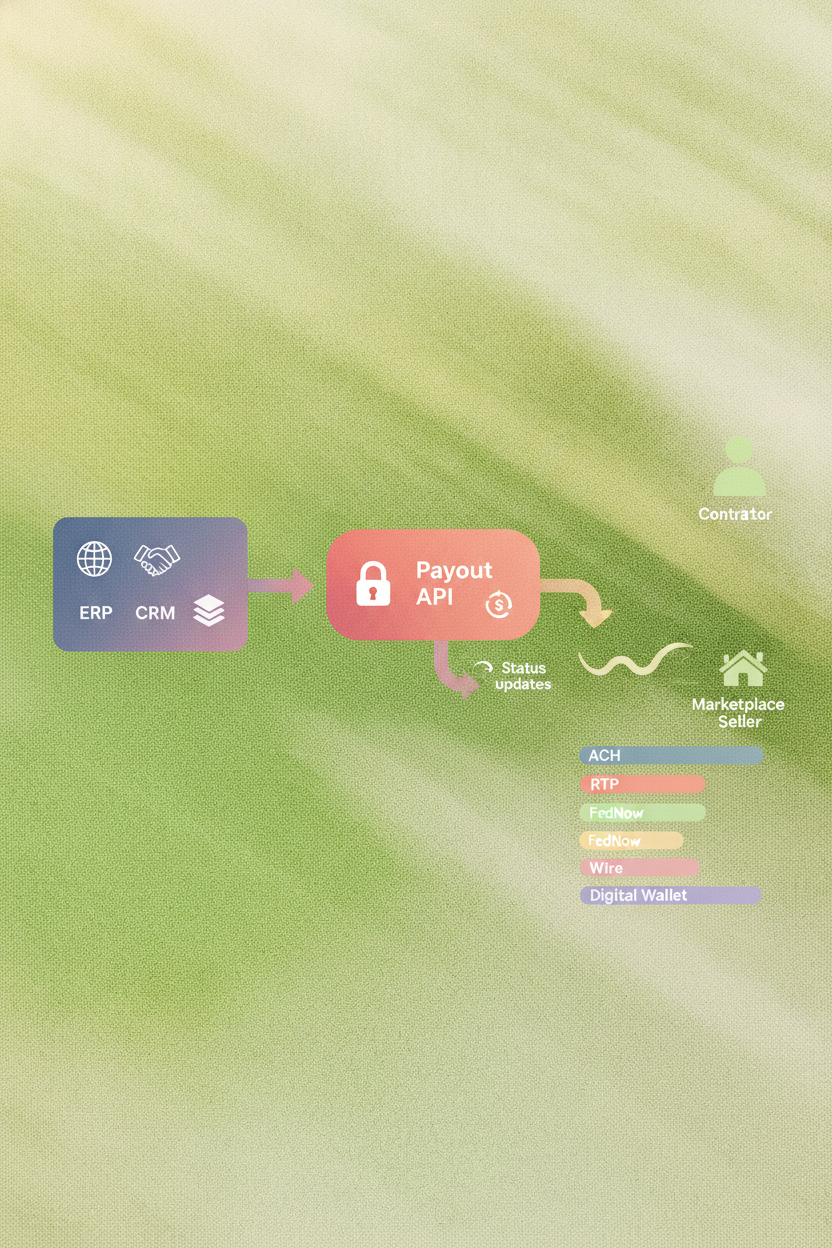
Payment API integration is the technical process of connecting your company's existing software, such as an ERP, CRM, or custom-built marketplace software, with a payment service provider's infrastructure. This connection allows for the real-time exchange of data, so that when an action occurs on your product (like a seller reaching their withdrawal threshold), the corresponding payment is triggered automatically.
Successful integration takes a code connection plus work to align your internal data structures with the API's requirements. This includes configuring webhooks to receive status updates, securing authentication via API keys, and mapping data fields so recipient information stays accurate. When done correctly, integration removes the need for CSV uploads or manual bank logins, creating a closed-loop system where financial data flows securely and automatically between systems.
How Do I Integrate an API?
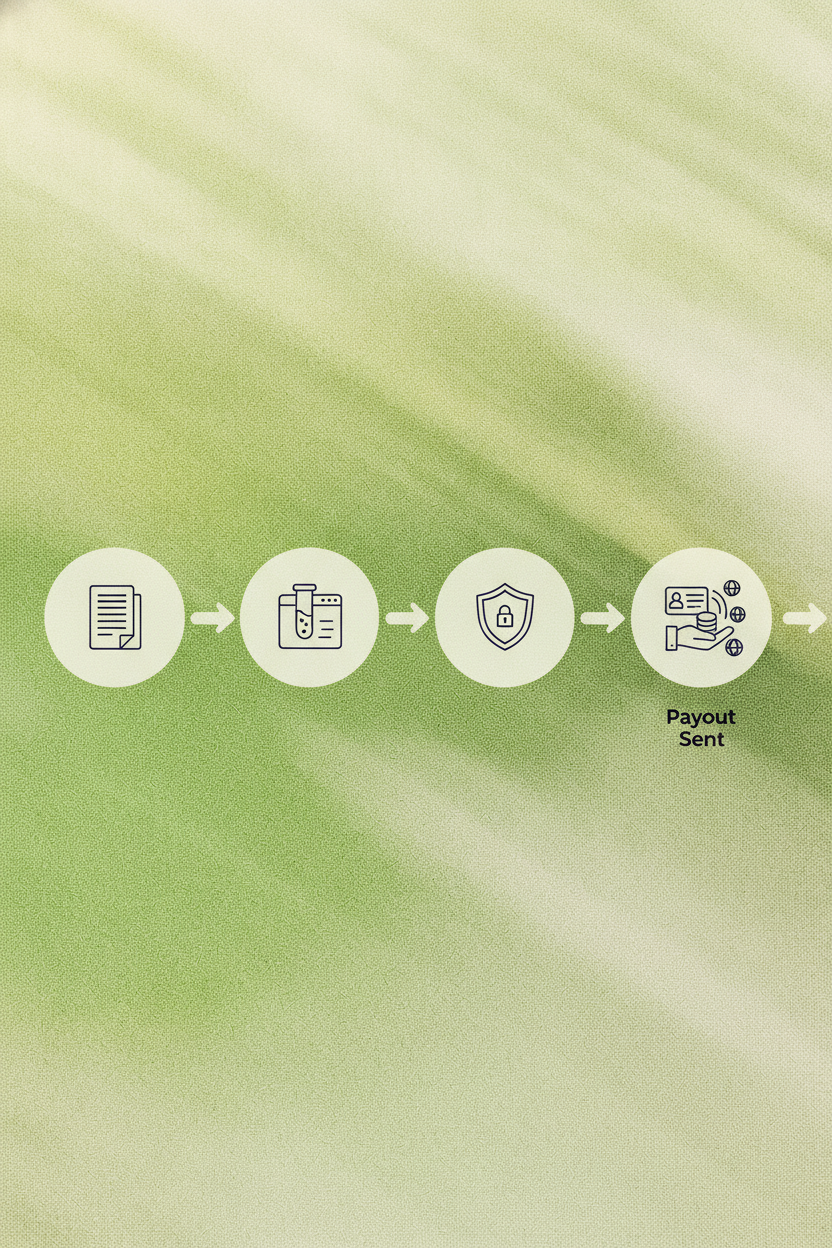
Integrating a payout API takes a structured approach to security, compliance, and functionality. While the specific code depends on the provider, the general workflow follows these four core steps.
Step | What You Do | What It Prevents |
|---|---|---|
1. Documentation Review | Map endpoints, parameters, authentication and callbacks | Gaps in handling failed transactions or insufficient funds |
2. Sandbox Testing | Simulate payouts, invalid bank details, rate limits and webhooks | Bugs reaching live money movement |
3. Security Protocols | Use TLS 1.2 or higher, secure API key storage and tokenization | Exposure of PII and bank details |
4. KYC and Tax Onboarding | Verify identity and collect W-9s or W-8BENs before the first payout | AML/KYC violations and missed tax forms |
1. Technical Documentation Review
The first step is a thorough assessment of the API documentation. This resource outlines the available endpoints, required parameters, and authentication methods. Developers must understand the payment flow: from creating a user profile to initiating a transfer and handling callbacks. Understanding how the API handles edge cases, such as failed transactions or insufficient funds, is critical for building a resilient integration.
2. Sandbox Testing and Development
Before moving to a live environment, developers use a "sandbox" or test environment. This allows you to simulate transactions and test your code without moving real money. During this phase, you should test various scenarios, including:
- Successful payout triggers.
- Error handling for invalid bank details.
- The impact of rate limits on high-volume batches.
- Webhook reliability for real-time status updates.
3. Implementing Security Protocols
Because you are handling sensitive financial data, security cannot be an afterthought. Integration must include strong encryption (TLS 1.2 or higher) and secure storage of API keys. Modern payout APIs often use tokenization to protect personally identifiable information (PII), so that sensitive data like social security numbers or bank account details never sit on your local servers in a vulnerable state.
4. Identity Verification and KYC
Compliance is a core part of the integration process. To meet Anti-Money Laundering (AML) and Know Your Customer (KYC) regulations, your integration must support the collection of recipient information. A sophisticated API will provide built-in tools for identity verification and tax form collection, such as W-9s (US tax identification forms) or W-8BENs (foreign status certification forms), automating the "onboarding" of your payees before the first dollar is sent.
What Changed for Payout Integrations in 2026
Under the One Big Beautiful Bill Act changes, the 1099-NEC and 1099-MISC (IRS forms that report contractor and other non-employee payments) reporting threshold rose from $600 to $2,000 for payments made after December 31, 2025, and the 1099-K threshold returned to $20,000 and 200 transactions. Your payout integration's tax logic must track per-payee cumulative totals against the new threshold so that forms are triggered at the right point and no payee is missed or over-reported.
In November 2025 the Federal Reserve raised the FedNow transaction limit increase, lifting the per-transaction cap on FedNow (the Federal Reserve's instant payment service) from $1 million to $10 million. This makes larger instant payouts practical, so your API should route to real-time rails where available instead of defaulting to slower batch methods.
Choosing the Right Infrastructure for Scalability
Not all payout solutions are equal. Some traditional providers offer rigid systems that require extensive custom coding for every new payment rail you wish to add. Others may have hidden fees or lack the global reach required for international expansion.
When comparing your options, consider these four pillars:
- Scalability: The provider should handle ten payouts or ten thousand with the same level of performance.
- Reliability: High uptime and redundant payment rails are necessary to prevent delays that could damage your reputation with contractors.
- Support: Access to technical experts during the integration phase can cut weeks off your time-to-market.
- Global Reach: The ability to pay recipients in their local currency via their preferred method, whether that is a local bank transfer or a digital wallet, is a clear competitive advantage.
How to Optimize Your Financial Operations with Dots
Integrating a payout API is a strategic investment in your business's future. While some well-known legacy processors offer limited payout functionality as an add-on to their core merchant services, Dots is built for disbursements from day one.
Our platform provides a unified infrastructure that simplifies the entire lifecycle of a payout. From automated onboarding and tax compliance to multi-rail distribution, Dots API allows you to manage global payments without the overhead of building separate integrations for every country or payment type. By choosing a dedicated payouts partner, you avoid the common pitfalls of "all-in-one" processors that often lack the specialized compliance tools and flexible payout options that modern marketplaces require.
Dots keeps your integration secure, compliant, and ready to grow alongside your business. By automating the heavy lifting of financial processes, your team can focus on core product development instead of manual payment management.
See how the Dots API can cut manual payout work for your team. Schedule a demo with our team today to experience the Dots difference.
FAQs
How can I automate sending payments to people?
Connect a payout API to your system so events, such as a seller hitting a withdrawal threshold or an approved invoice, trigger payments automatically. Webhooks report status back to your system at each step, so your team always knows where a payment stands.
How do I send thousands of payments automatically?
You can send payouts in batches through the API, or upload a CSV in the Dots dashboard if your team prefers a non-technical option. Dots moves $1.5bn a year to more than 1 million payees, so the same setup works whether you are sending ten payments or ten thousand.
How can I offer instant payments to contractors?
You can route payouts over real-time rails such as RTP (Real-Time Payments) and FedNow (the Federal Reserve's instant payment service), which settle in seconds versus 1 to 5 business days for ACH. Dots uses real-time rails by default where supported, with no instant-payout surcharge and no daily payout cap.
What is the best way to pay affiliates automatically?
You can trigger commission payouts from your affiliate tracking data via API on a set cadence, such as daily, weekly, or real time, configurable per payee tier or region. Collect W-9s (US tax identification forms) up front and let payees pick their own payout method.
What payment rails and payout methods does Dots support?
Dots supports RTP, FedNow, ACH, Venmo, CashApp, SWIFT, PIX (Brazil), UPI (India), and 300+ payout methods across 190+ countries. That includes bank transfers, mobile money, digital wallets, and stablecoins.
How does the withdrawal flow work, and can it be white-labeled?
Payees open a white-labeled recipient portal carrying your brand, select their preferred payout method from 300+ options, and confirm it. Dots fires a payout-method confirmation webhook so your system knows funds can move, and recipients contact Dots support directly with questions.
How does Dots handle 1099 reporting?
Dots Tax collects W-9s, runs TIN (Taxpayer Identification Number) matching before payouts clear, and generates and files 1099s, including multi-state 1099-NEC routing. It tracks payee totals against the $2,000 1099-NEC threshold that applies to payments made in 2026.
When does Dots request KYC information?
Dots requests KYC (Know Your Customer) information at onboarding, before the first payout goes out. Identity verification approval or failure webhooks let you gate payout access until verification and tax-form collection are complete.
Does Dots support crypto or stablecoin payouts?
Dots supports wallets and stablecoin-based payment corridors as a lower-cost alternative to SWIFT for cross-border payouts. This gives you another option when speed and cost matter more than traditional bank rails.
What fraud protection is built into Dots?
Every payee is screened against global watchlists, and liveness detection blocks printed photo, replay video, and AI-generated face spoofing during document capture. Account and routing details are validated before disbursement, so funds reach the right recipient.