How Long Do Global Wire Transfers Take? (October 2026)

Managing Your Payments
Are there people outside of the United States you need to pay? With increasing numbers of companies working with global partners and contractors, international payments are more common than most realize. While there are many ways to perform these transactions, one of the most common methods is to do a wire transfer. Wire transfers let you move money from one bank to the next without taking out cash or writing a check. They’re pretty efficient when done domestically, but what about cross-border transfers?
The average international wire transfer takes 1 to 5 business days. Swift payment speed data shows 90% of cross-border payments reach the destination bank within an hour, but the final credit to your payee's account often takes much longer. Understanding what happens behind the scenes, and the factors that affect transfer times, helps you manage these payments with fewer surprises.
TL;DR
- International wires typically take 1 to 5 business days to fully settle.
- Most Swift payments reach the destination bank fast, but the final credit to the payee's account often takes much longer.
- Cutoff times, weekends, bank holidays, time zones, and correspondent bank activity all drive delays.
- Accurate IBAN and BIC/SWIFT details prevent rejections, especially now that ISO 20022 became the standard for cross-border messaging in November 2025.
- Local instant rails and Dots payouts cut wait times for payees who need funds fast.
A Brief Overview
When you initiate a wire transfer, you’ll usually see the money leave your account pretty quickly. However, it could be several days until your recipient sees it in their foreign bank account. What gives?
Wire transfers are a way to move money electronically without exchanging physical cash. In our increasingly digital world, that’s nothing especially new. In many ways, these transactions are relatively archaic and still rely on back-and-forth communication from the payer’s bank to the receiver’s.
The journey payments take for cross-border payouts involves more steps than most people realize. It all starts with the initial transfer request.
Timing matters a lot here, and the one- to five-day transfer time hinges on when you begin the process. The best time to make a request is on a typical business day. For banks, that’s any day between Monday and Friday.
Ideally, you’d send the payment before your bank’s cutoff time. Here’s where you’ll have to research your bank’s processes.
Many financial institutions have strict cutoff times for international wire transfers. This is usually the end of the business day, around 5:00 p.m. However, some banks will stop processing global transactions earlier, making the cutoff time for these wire transfers different from all other transaction types. There’s no universal cutoff, so you’ll need to inquire about how your bank does things.
If you request an international transfer on a business day before the cutoff time, it should process by closing time. That’s when you’ll see the funds leave your account. If you miss the cutoff time, it’ll process the following business day. Remember: Weekends are generally non-business days, so late requests made on a Friday won’t be processed until Monday.
After the money is out of your hands, all you have left to do is wait.
From there, several steps will occur to complete this cross-border transaction. Instructions for the payment will move through the SWIFT network. SWIFT is an acronym for the Society for Worldwide Interbank Financial Telecommunication. It's the global messaging network that financial institutions use to carry out transactions, send information, and communicate transfer instructions.
Your international wire payment will pass through as many as three different intermediary banks before getting to the recipient's bank. But wait. There's more!
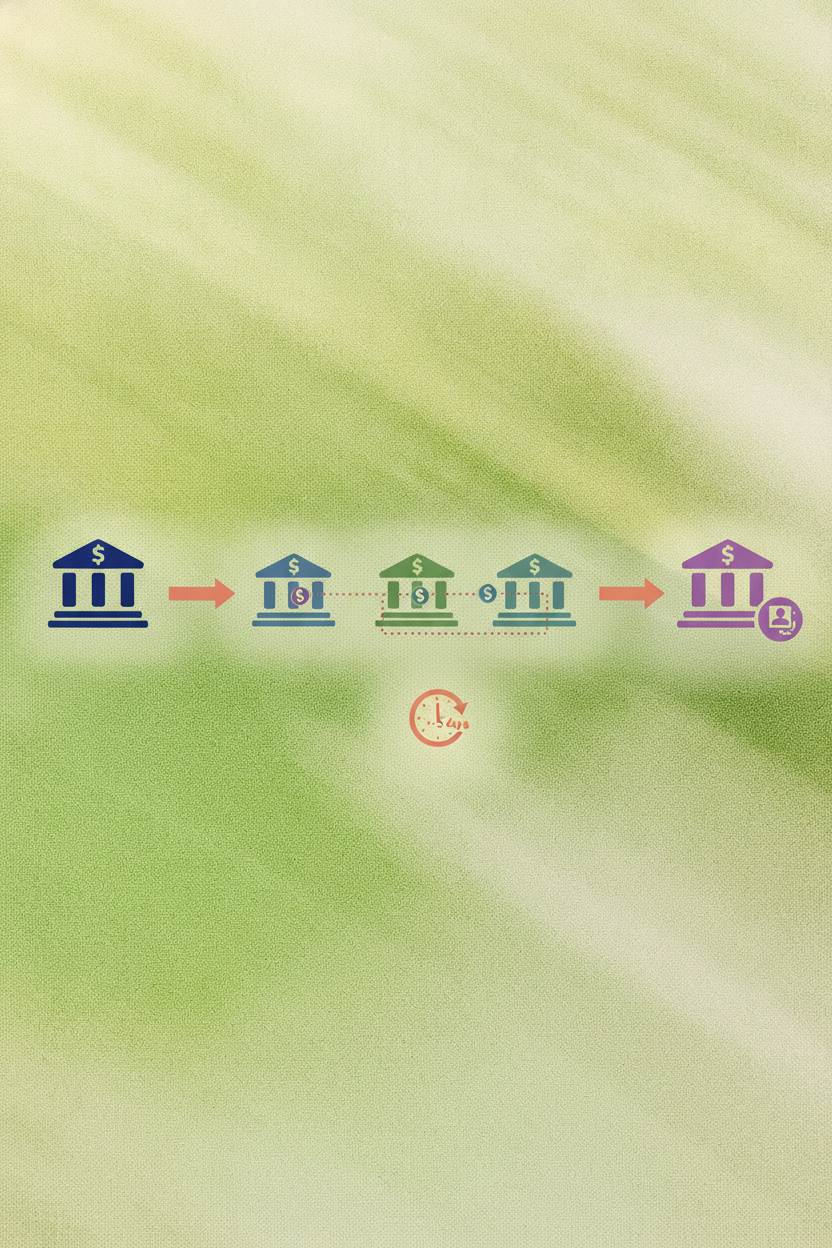
After getting to your contractor’s foreign bank, there are still many processing steps before the money hits the account and is available to spend. It’s a long process, and account holders don’t see any of it. All the information exchange happens behind the scenes, making the payment possible.
How to Track an International Wire Transfer
Ask your bank for the UETR (Unique End-to-End Transaction Reference), the tracking number Swift attaches to each cross-border payment. With that reference, your bank can look up where the wire sits in the chain of intermediary banks.
If a wire is late past 5 business days, contact your bank with the UETR and confirm the payee details on file. Returned wires can come back minus fees and exchange-rate differences, so catching a problem early matters.
Information You Need
Now that you know more about how international wire transfers work and the key step of communicating instructions through SWIFT, let’s go over the information you need. Before you send payments to a non-U.S. bank, you must provide a few critical pieces of information.
Without this data, you could send money to the wrong place or create lengthy delays. No one likes to wait longer than necessary to get their hard-earned cash, so triple-checking the instructional information is the most important thing of all.
The exact tidbits of data you’ll need can vary between banks, but the list usually includes the following.
Identifying Information
Of course, the most critical pieces of data revolve around where the money goes. Contrary to popular belief, you typically don’t have to provide account holder names. Instead, the focus is on the destination bank.
To make sure the money gets where it needs to go, you must provide the name and location of the recipient’s bank. You’ll also need to supply the Business Identifier Code (BIC), also called the SWIFT code (Society for Worldwide Interbank Financial Telecommunication), of the bank so that instructions go through correctly.
Finally, there’s the International Bank Account Number (IBAN). This number directs the receiving bank to put the funds into the correct account.
Transaction Details
Next comes the financial information. These tidbits of data cover the transfer amount and the currency the recipient will get. Technically, you could send payments in USD, but it’s common courtesy to pay international contractors in their legal tender.
It’s one less thing they have to worry about after getting paid. Conversion is automatic into the chosen currency.
Fees and Contextual Information
Finally, most banks require you to provide some context about the payment. This information is often used for compliance checks and to avoid delays. Again, the exact details can vary. Typically, banks will ask for the reason behind the transfer.
You’ll also need to specify who pays the associated transaction fees. As a company paying a contractor, you can pay them all yourself. However, there’s also the option to pass costs on to the recipient or do an even 50/50 split.
Factors to Consider
If you do everything correctly, things should move pretty smoothly. However, you could run into a few delays. With instructions traveling through so many hoops, issues can arise. Many are out of your hands, but you can be strategic in your transfer request to avoid hiccups as much as possible.
There are several factors that could impact the international wire transfer timeline.

Here is a quick look at the main factors and how to manage each one.
Factor | Why It Slows the Transfer | What You Can Do |
|---|---|---|
Time zones | Sending and receiving banks are not open at the same time | Send early in your bank's business day |
Weekends and bank holidays | Banks on either end pause processing | Check both countries' holiday calendars first |
Incorrect banking details | Wrong IBAN or BIC/SWIFT code blocks the transfer | Triple-check every number before sending |
Currency conversion | Converting to local tender takes extra steps | Confirm rates and timing with your bank |
Correspondent banks | Extra intermediary banks add processing steps | Ask if a direct bank relationship exists |
Compliance checks | Transfers undergo anti-fraud and legal review | Provide clear, complete transaction details |
Different Time Zones
Sometimes something as simple as different time zones creates delays. Many people time their transfer requests to start the process on the same day. But if the destination bank is on the opposite side of the world, getting the timing right isn’t easy.
Your bank might be open and processing transactions, but it could be in the middle of the night for the recipient’s bank. That could slow things down a bit and prevent quicker completion.
Weekends and Bank Holidays
Don’t forget to check on bank holidays and weekends. During a bank holiday, international wire transfers do not process. That applies both ways. While it’s relatively easy to avoid the holidays in your country, your contractor’s country may close banks for holidays you don’t know about, such as Golden Week in Japan or Diwali in India. Do some research to make sure you’re avoiding those days entirely.
The same goes for weekends. In most countries, weekends are the same. However, there are several exceptions. For example, countries like Egypt consider Friday and Saturday to be weekends instead of Saturday and Sunday.
Incorrect Banking Information
Here’s a delay that you can avoid. Incorrect banking details are a surefire way to stretch out how long it takes to complete an international wire transfer. Triple-check all bank numbers. Pay attention to the IBAN and BIC/SWIFT codes. Even one incorrect digit can prevent the transaction from going through.
Currency Exchanges
It’s standard for companies to pay global contractors in their local currency, but doing so can cause moderate delays. Converting money into a new tender takes time. There’s not much you can do aside from being strategic about when you initiate a transfer.
Correspondent Bank Activity
Remember how we said international wire transfers sometimes go through as many as three intermediary banks? The exact number can affect how long the transfer takes to complete. Intermediary banks, also known as correspondent banks, act as the middlemen. They handle transactions on behalf of another financial institution to move money.
If your bank has a direct bilateral agreement with the recipient’s bank, the transaction won’t need to go through any intermediary institutions. This can speed things up by a lot.
Compliancy Delays
Earlier, we mentioned that you must provide context about the transaction. Here’s why. Financial institutions follow strict laws and regulations that are in place to fight nefarious activity. These rules help combat terrorism funding, money laundering, and other illegal practices.
Oftentimes, international wire transfers are subject to more thorough checks than domestic transactions. While this can be frustrating, banks must go through those steps to confirm that your transfer is legal.
Slow Bank Infrastructure
Last but not least, there’s the bank infrastructure. In developed countries like the United States, the system of moving money is well designed. Banks can communicate efficiently, making it possible to do same-day transfers. But that’s not the case everywhere. Some countries are still developing their bank infrastructure, leading to slower processing times across the board.
What's Changed for International Wire Transfers in 2026
The SWIFT network finished a major messaging upgrade in late 2025. On November 22, 2025, the coexistence period for legacy MT messages ended, and ISO 20022 payment messaging became the standard for cross-border payment instructions between banks.
For you, richer and more structured payment data now travels with every wire. Banks can screen transfers with fewer manual checks, which cuts the back-and-forth that used to stall payments. The catch: incomplete or badly formatted payee details are more likely to trigger a rejection, so accurate locations and identifiers matter more in 2026.
Faster messaging still does not fix weekends, holidays, or slow infrastructure on the receiving end. If your payees need funds in seconds instead of days, local instant rails such as PIX (Brazil's real-time payment system) and UPI (India's real-time payment system) settle without waiting on correspondent banks. Dots routes payouts across 300+ local rails in 190+ countries for exactly this reason.
How to Speed Up an International Wire Transfer
A few practical steps can shave real time off a cross-border payment before it ever leaves your bank.
- Send the request before your bank's cutoff time on a standard business day.
- Check the holiday calendar for your country and the recipient's country before scheduling the transfer.
- Verify the IBAN, BIC/SWIFT code, and full payee address before submitting the payment.
- Pay the recipient in their local currency and state clearly who covers the transfer fees.
- Use a payout provider like Dots that routes over local rails when speed matters most.
Are They Secure?
Whether making a handful of payments or batch payouts to multiple contractors, it’s always intimidating to perform international transactions. Being concerned about safety is understandable. However, you don’t have too much to worry about in terms of security. The transfer should go smoothly, even with delays, as long as you provide the correct information.
The communication system banks use to carry out these transactions is very safe. SWIFT uses standardized code to transmit instructions. On top of that, there are multiple processing steps involved. From a sender’s perspective, it seems like the money leaves and ends up in the recipient’s account. But behind the scenes, that money is moving through multiple secure banks and safe financial channels.
Security incidents are uncommon when you follow your bank’s protocols and send accurate payee details. If a wire goes astray, your bank can trace it with the UETR.
Get Started With Dots Today
When you need to perform an international wire transfer to pay foreign contractors or influencers, turn to Dots, the developer-friendly global payout infrastructure. The Dots API is a friction-free alternative to standard transfer requests. Send money quickly and efficiently without headaches.
We handle all the logistics, including tax document collection and global watchlist screening. With Dots, you can schedule recurring payments, do one-off transfers, and create custom money flows that work for your business. Complete payouts and pay your global collaborators on time with help from Dots. Schedule your consultation today to learn more!
FAQs
How long does an international wire transfer take?
The average international wire transfer takes 1 to 5 business days. Swift payment speed data shows 90% of cross-border payments reach the destination bank within an hour, but the final credit to your payee's account often takes much longer.
Why is my international wire transfer delayed?
Delays usually come from different time zones, weekends and bank holidays, incorrect banking information, currency exchanges, correspondent bank activity, compliance checks, or slow bank infrastructure on the receiving end. Triple checking the IBAN and BIC/SWIFT codes before you send a payment helps you avoid the most common cause of delay.
Can I send an international wire on a weekend?
Weekends are generally non-business days, so a request made after your bank's cutoff time on a Friday will not process until Monday. During a bank holiday, international wire transfers do not process either, and that applies both ways between your bank and the recipient's bank.
What information do I need to send an international wire?
You need the name and location of the recipient's bank, its Business Identifier Code (BIC)/SWIFT code, and the recipient's International Bank Account Number (IBAN). You also need the transfer amount and currency, plus context about the payment reason and who pays the transaction fees.