Paying EU Creators via SEPA Instant: VAT, KYC & Settlement

Most teams routing european creator payouts assume the hard part is picking the right rail. It's not. SEPA Instant handles settlement in under ten seconds for sepa instant creators across 36 countries. The friction comes from what surrounds it: collecting the right tax data before funds move, handling VAT correctly across jurisdictions, and running KYC checks that hold up under EU rules. This post covers all three so eu influencer payments go out the same day, without the compliance gaps that come back later.
TLDR:
- SEPA Instant settles funds in under 10 seconds, replacing multi-day batch processing for EU creator payouts.
- DAC7 (Council Directive EU 2021/514) requires tax data collection before funds move, not after.
- VAT treatment varies by buyer location and transaction type, creating audit risk without proper routing logic.
- SEPA Instant covers 36 countries, but UK, Polish, and Swedish creators need separate local rail access.
- Dots routes EU creator payouts through SEPA Instant and 300 local networks via a single API.
The European Creator Economy at Scale
Millions of independent earners rely on digital services for their livelihoods. When you manage european creator payouts at scale, infrastructure decisions carry heavy financial weight.
Cross-border earnings within the EU trigger overlapping tax obligations and strict verification laws before a single euro moves.
Fragmentation across local banking networks historically delayed settlement times. Today, the European real-time payments market has shifted decisively toward instant settlement. SEPA Instant now reaches over 36 countries, and the EU's Instant Payments Regulation mandates that eurozone banks send and receive instant transfers at standard SEPA pricing. For teams managing european creator payouts at volume, that infrastructure shift means same-day disbursements are no longer a premium feature: they are the baseline expectation.
What SEPA Instant Is and How It Works
When routing european creator payouts, clearing speed relies on the payment network. SEPA Instant Credit Transfer replaces batch processing with immediate fund routing, ending hold periods lasting multiple days.
For sepa instant creators, this infrastructure operates under rigid mechanics:

- Speed: Funds clear within ten seconds of initiation, per ECB payment statistics. That settlement window applies around the clock, 24 hours a day, 365 days a year, with no batch processing delays and no cutoff times tied to banking hours. For services disbursing to SEPA Instant creators across time zones, that means a creator in Berlin and one in Lisbon both receive funds in the same sub-ten-second window, regardless of when the payout runs.
The EU Instant Payments Regulation and What Changed in 2025
When you route eu influencer payments, the legal foundation governing those transfers changed. The Instant Payments Regulation entered into force on April 8, 2024. This mandate forces eurozone banks to receive and send instant transfers by January and October 2025, capping fees at standard SEPA Credit Transfer pricing. Payment institutions adopt these rules between 2027 and 2028.
DAC7: What Creator Services Must Collect and Report
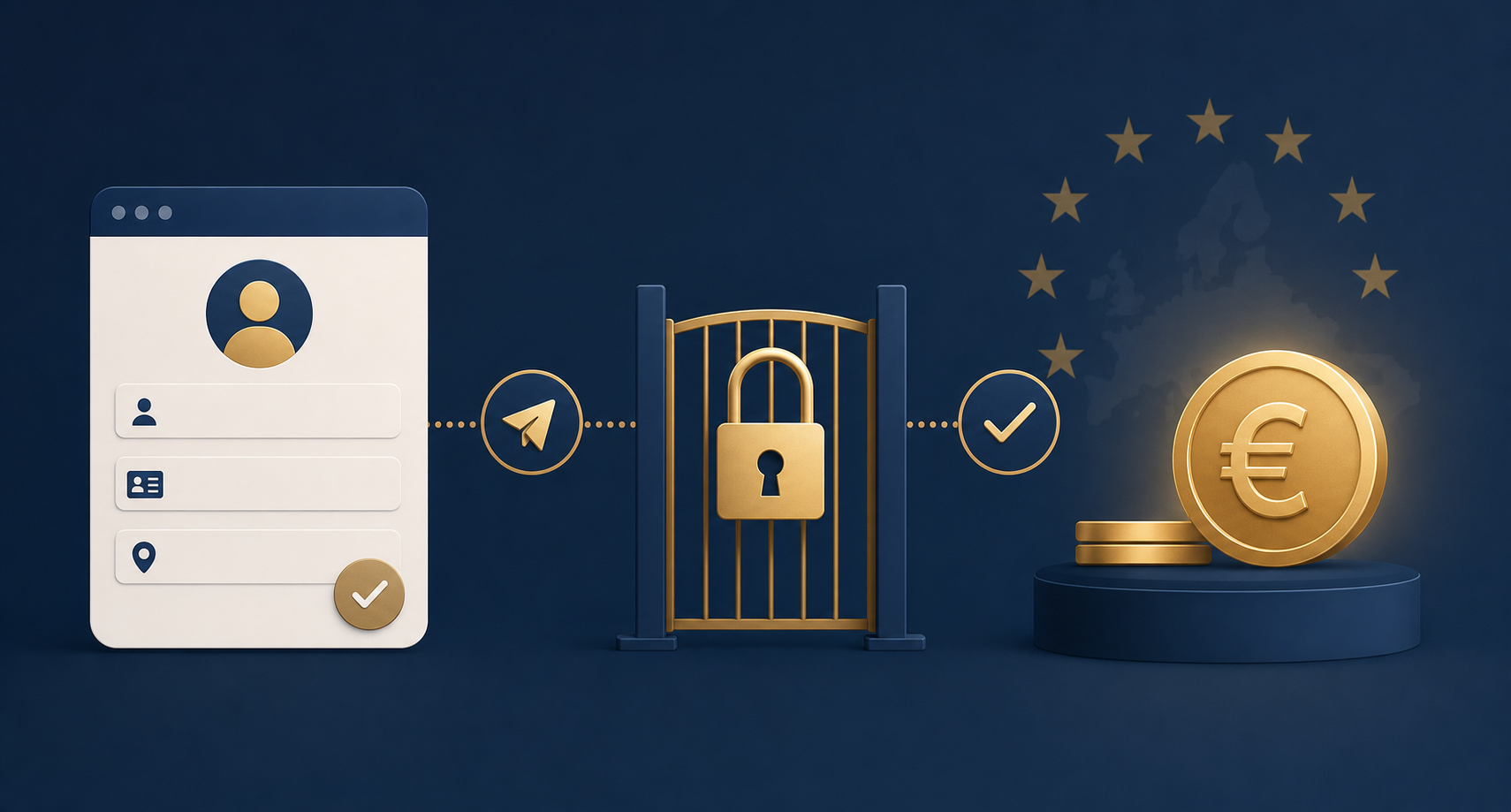
If you route european creator payouts at scale, tax obligations begin before funds move. Known as Council Directive EU 2021/514, DAC7 mandates that digital services collect and report seller and creator tax data to EU member state authorities annually, covering full legal name, registered location, tax identification number, and total consideration paid per payee. Services must gate payouts on completed tax-form submission: a creator who accesses funds before supplying that data puts your business in breach of the directive, exposing you to penalties enforced at the member-state level. Reporting deadlines run to January 31 of the year following each calendar year, so the collection workflow must be embedded in onboarding, not bolted on at year-end.
VAT Obligations Across the EU Creator Economy
Value-added tax adds friction to eu influencer payments. The exact VAT treatment of influencers varies based on the buyer's location and transaction type: a creator selling digital services B2C to consumers in another EU member state may trigger VAT registration obligations in that country, while B2B transactions can shift the liability to the buyer under the reverse charge mechanism. Services disbursing to creators must classify each transaction correctly before funds move: applying a flat VAT rule across your entire payout batch produces mislabeled transactions that create audit exposure across multiple jurisdictions. EU OSS (One Stop Shop) registration helps consolidate cross-border B2C VAT filings into a single return, but it does not eliminate the need for per-transaction classification logic built into your payment flow.
KYC Requirements for European Creator Onboarding
EU anti-money-laundering rules require services to verify government-issued IDs from all 27 member states before a creator reaches payout-eligible status. That means accepting passports, national ID cards, and residence permits issued in different languages and formats, and running active liveness checks such as blink detection or head rotation to block printed photo attacks, replay video, and AI-generated face spoofing. Services must also screen each payee against sanctions lists and politically exposed person (PEP) databases before funds move, not as a one-time onboarding step but on an ongoing basis as those lists update.
Payment Rails Beyond SEPA: Local Methods Across Europe
SEPA Instant covers euro accounts across 36 SEPA countries, but routing European creator payouts often extends past the eurozone. While immediate clearing is standard for SEPA instant creators, payees outside this region rely on slower paths unless you access local networks.
Key regional options include:
- UK Faster Payments for British accounts
- Polish BLIK for local mobile transfers
- Swedish Swish for real-time mobile transfers in Sweden
- Romanian Fast Payment and Hungarian AFR for regional instant settlement outside the eurozone core
Payment Rail | Country / Region | Transfer Type | Settlement Speed |
|---|---|---|---|
SEPA Instant | 36 SEPA countries (eurozone) | Credit transfer | Under 10 seconds |
UK Faster Payments | United Kingdom | Bank transfer | Seconds |
BLIK | Poland | Mobile transfer | Real-time |
Swish | Sweden | Mobile transfer | Real-time |
Romanian Fast Payment | Romania | Bank transfer | Instant |
Hungarian AFR | Hungary | Bank transfer | Instant |
Where Standard Payout Infrastructure Breaks Down for European Creators
Managing european creator payouts through generic software fractures workflows. Standard systems treat independent earners like corporate vendors, creating costly gaps across tax, verification, and settlement.
- DAC7 reporting fails when tax collection lives outside the core payment flow, triggering compliance penalties if payees access funds before submitting data.
- Generic infrastructure mislabels transactions and creates VAT audit risks when your legal entity structure contradicts local VAT rules: for example, applying a single VAT treatment across B2B and B2C payouts, or ignoring reverse-charge obligations when disbursing to business creators in other member states. Without per-transaction classification logic built into the payment flow, each mislabeled disbursement compounds audit exposure across every jurisdiction where your creators operate. Correcting those misclassifications after the fact requires manual reconciliation across multiple tax authorities, multiplying both the cost and the compliance risk.
How Dots Supports European Creator Payouts
Managing European creator payouts requires infrastructure that resolves compliance and routing complexity. We built Dots to handle this entire lifecycle through a single API, moving $3bn+ to over 1 million payees across 190 countries.
Here is how we support EU influencer payments and SEPA instant creators at production scale:
- Routing funds immediately through SEPA Instant and 300 local networks: eurozone creators settle in under ten seconds, while UK, Polish, and Swedish payees reach local rails like Faster Payments, BLIK, and Swish through the same API call, no separate provider contracts required.
- Gating payouts on DAC7-compliant tax-form submission: creators cannot access funds until they supply their full legal name, registered location, and tax identification number, keeping your system in compliance with Council Directive EU 2021/514 before a single euro moves.
- Running per-transaction VAT classification so each disbursement carries the correct treatment (B2B reverse-charge, B2C OSS-eligible, or domestic) before it settles, eliminating the audit exposure that accumulates when a single VAT rule is applied across an entire payout batch.
- Verifying creator identity against government-issued IDs from all 27 EU member states, running active liveness checks, and screening payees against sanctions lists and PEP databases on an ongoing basis, so KYC status is current at every payout, beyond initial onboarding.
Final Thoughts on Managing EU Influencer Payments at Scale
Speed is only part of the story for European creator payouts. Tax reporting, VAT treatment, and KYC verification all have to work in the same flow, not in separate tools bolted together after the fact. Your payees feel every gap in that chain. Reach out to Dots to see how production-scale routing actually works.
FAQ
What's the difference between SEPA Instant and standard SEPA Credit Transfer for european creator payouts?
SEPA Instant settles funds within ten seconds, while standard SEPA Credit Transfer runs on batch processing that can hold funds for multiple business days. For european creator payouts at volume, that gap translates directly into creator cash flow and your support ticket load.
Can I route eu influencer payments across Europe using a single API without stitching together multiple local rails?
Yes. A payout infrastructure layer like Dots routes through SEPA Instant for eurozone accounts and connects to local networks (UK Faster Payments, Polish BLIK, Swedish Swish) through the same API call, so you do not manage separate provider contracts per country. The alternative forces your team to maintain multiple integrations and consolidate them manually at scale.
How does DAC7 affect when I can release funds to European creators?
DAC7 requires digital services to collect and report creator tax data before funds move, meaning you must gate payouts on completed tax-form submission, not after. If your compliance collection lives outside your core payment flow, creators can access funds before reporting obligations are met, exposing your business to penalties under Council Directive EU 2021/514.
What KYC requirements apply when onboarding creators across EU member states?
You must verify government-issued IDs from 27 member states and run active liveness checks (such as blink detection or head rotation) to block printed photo attacks, replay video, and AI-generated face spoofing. KYC must complete and return a verified status before any creator reaches payout-eligible status, or you carry the fraud liability.
What's the best way to handle VAT compliance for sepa instant creators operating across multiple EU countries?
VAT treatment for EU creators depends on the buyer's location and transaction structure, not solely where the creator is based, which means a single VAT rule applied across your entire payout batch will produce mislabeled transactions and audit risk. The safest approach is jurisdiction-aware VAT classification built into the payment flow itself, so each disbursement carries the correct treatment before it settles.