Best Payout APIs for Gig Economy Platforms

Building payments for gig workers means solving for speed and choice at the same time. 81% of your workers want instant access to their earnings, but they also want flexibility in how they receive funds. The payments API you choose determines whether you can deliver both, and whether your team ships in days or waits months.
TLDR:
- Payout APIs automate payments to gig workers across borders with KYC, tax filing, and routing.
- Dots reaches 190 countries via 300 rails with real-time settlement and no instant payout fees.
- Stripe limits instant payouts to 9 markets with a 1.5% fee and 10-transaction daily cap.
- Tipalti and Trolley require 4-6 week onboarding and settle in 1-5 days via ACH or wires.
- Dots integrates in under a week with transparent pricing: $999/month plus flat transaction fees.
What are Payout APIs for Gig Economy Platforms
A payout API is a developer tool that automates payments to gig workers, contractors, and freelancers. Instead of manually processing thousands of weekly payments, you integrate code that runs payouts automation across the full cycle, from onboarding through disbursement.
These APIs collect payee information, verify identities, handle tax documentation like 1099s, check compliance requirements, and route funds through the optimal payment rail, whether bank transfer, mobile money, or digital wallet.
What Makes Payout APIs Different
What separates payout APIs from basic payment processors is scope. A processor charges a credit card. A payout API manages the full lifecycle of paying people at scale, across borders, with different regulatory requirements in each market.
For gig economy businesses, that difference matters. You're not running payroll for W-2 employees. You're sending earnings to thousands of independent workers in dozens of countries who expect fast, flexible payment options. The same logic applies to marketplace payouts at scale: with contractor payouts growing more global, the difference between a capable payout API and a basic processor shows up directly in worker retention and growth.
How We Ranked Payout APIs for Gig Economy
We ranked each API against six criteria that matter when paying gig workers at scale.
Payment Speed
Payment speed measures how quickly funds reach recipients. Real-time settlement through RTP (Real-Time Payments) or FedNow outperforms next-day ACH, which beats multi-day batch processing.
Global Coverage
Global coverage counts supported countries and local payment rails. A provider covering 50 countries through correspondent banking is weaker than one supporting 150+ with in-country transfers, mobile money, and digital wallets.
Pricing Transparency
Pricing transparency separates flat fees from hidden markups. We favored clear monthly costs and transaction fees over percentage-based pricing that scales unpredictably or buries FX spreads.
Developer Experience
Developer experience measures integration time and API quality. Can your team go live in days or does onboarding take weeks? Is documentation clear?
Compliance Automation
Compliance automation covers KYC verification, AML (Anti-Money Laundering) screening, and tax form management. Manual processes don't scale past a few hundred payees.
Rail Diversity
Rail diversity tracks payment method options beyond basic bank transfers. Workers want Venmo, CashApp, mobile money, and even stablecoins.
Multi-Currency Settlement
Multi-currency settlement measures how well each API handles local currency disbursement across markets, from USD in the US and GBP in the UK to MXN in Mexico. FX transparency separates providers that apply mid-market rates from those that bury markups inside the conversion spread. We favored APIs that publish their FX methodology and pass competitive rates directly to payees.
Best Overall Payout API for Gig Economy: Dots
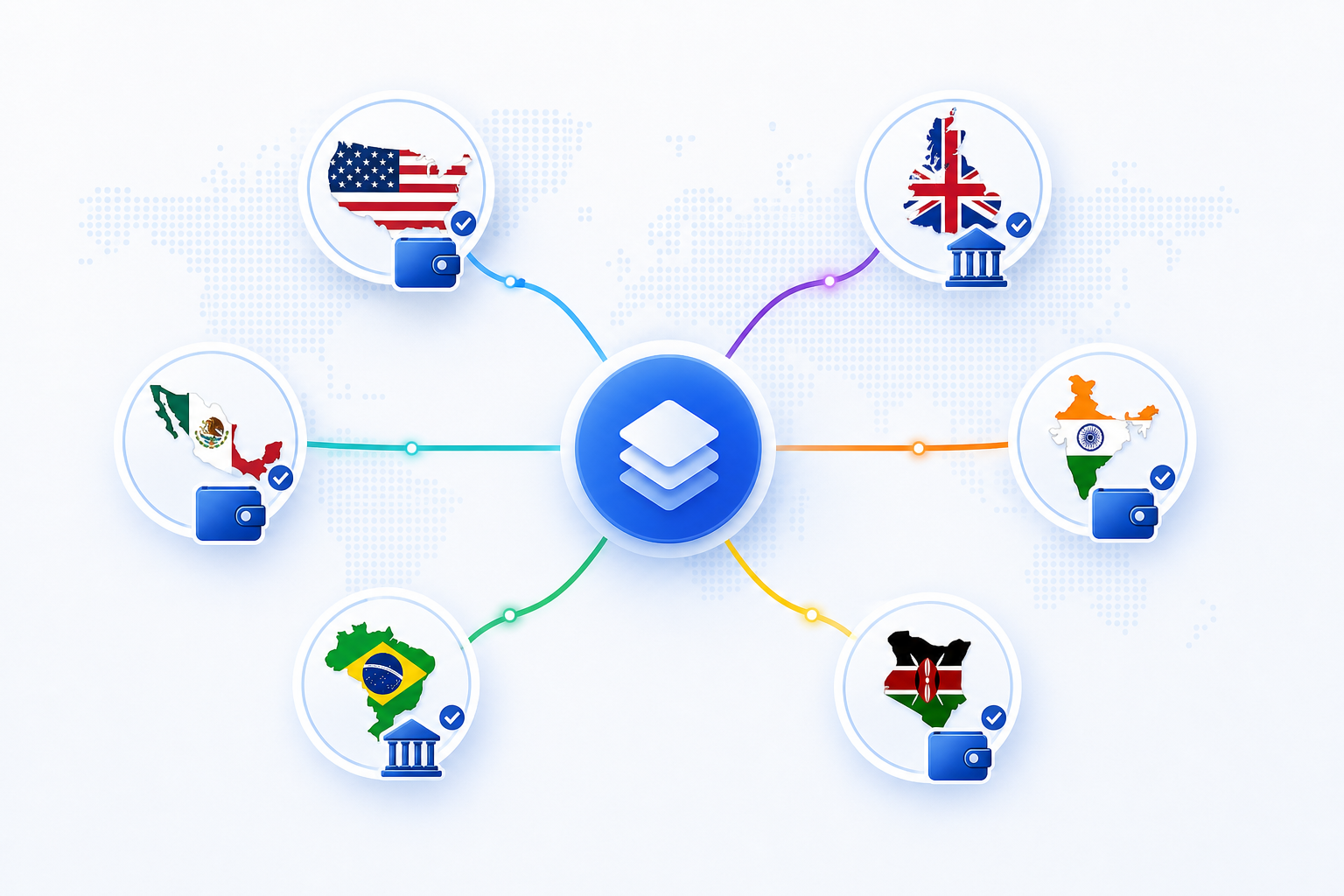
Dots supports payouts to 190 countries and 150 currencies, giving gig economy operators global reach without multi-vendor complexity. The API handles the full disbursement lifecycle: white-label onboarding flows that collect KYC (Know Your Customer) and tax forms, intelligent routing across 300 payment rails including RTP, FedNow, ACH, PIX, UPI, M-PESA, PayPal, Venmo, and wallets, automated 1099 filing at year-end, and payee support that removes ticket volume from your queue.
Global Reach and Instant Settlement
Dots delivers true instant settlement through a real-time payments API that connects to RTP, UPI, PIX, and SEPA Instant without surcharges. Most payouts clear in seconds on those rails, while ACH settles in 1-2 business days and international transfers typically arrive instantly or within 24-48 hours.
The payment integration takes under a week, with sandbox access and sample code powering test payouts within hours. Pricing is transparent: $999 per month, flat fees for domestic payouts, and percentage-based fees for international with mid-market FX rates.
Stripe
Stripe Connect and Stripe Payouts route payments to workers in 46 countries. The product suits teams already using Stripe for card acceptance who need basic disbursement features.
Stripe offers payouts to debit cards and bank accounts where it maintains local entities. Instant Payouts reach nine markets via debit card push, capped at 10 transactions daily. The service includes connected account infrastructure with KYC verification, webhooks, dashboard reporting, and API documentation.
Good for companies on Stripe for card payments who can accept multi-day ACH settlement and operate within the 46-country footprint.
Stripe Connect Limitations
Stripe Connect payout gaps a 1 to 1.5% instant fee, a 10-transaction daily cap, and debit-card-only instant payouts in nine regions. Cross-border transfers carry a 1% FX markup. Rail options exclude local methods like UPI, PIX, and mobile money.
Tipalti
Tipalti is a payments platform built for finance teams that need invoice approval workflows and ERP sync alongside contractor disbursements.
Tipalti disburses to 200 countries across roughly 50 rails including ACH, wires, and PayPal. The service includes AP workflow automation with multi-level approval routing, invoice matching, and ERP sync, plus tax compliance tools covering 1099 filing and W-9 (US tax identification form) collection for US contractors. Payees access a Tipalti-branded portal to submit bank details and track payment status.
Best for finance operations teams needing AP automation for invoices and willing to accept 1 to 3 day ACH settlement.
Tipalti Drawbacks
Drawbacks include 4 to 8 week implementations, 1 to 5 day settlement via ACH and wires, FX markup of 1.9 to 3.5% above wholesale rates, and the white-label portal pushing support inquiries back to your team.
Trolley
Trolley provides payout and tax infrastructure for contractors and affiliates across 210 countries, supporting 135 currencies through bank transfers, wires, and PayPal. The service includes a white-label recipient portal where payees enter bank details and track payment status, plus tax workflow tools for W-9 collection and 1099 filing. Plans start at $49 monthly plus transaction fees.
Good for small teams making basic international wire transfers who can wait 1 to 5 days for settlement.
Trolley Drawbacks
Drawbacks include 4 to 6 week bank rail activation before payouts begin, 1 to 5 day settlement windows, $10 per wire plus 2% FX markup, and rails limited to banks and PayPal. Real-time methods like RTP, UPI, PIX, mobile money, and wallets aren't supported.
How Multi-Currency Payouts Work in the US, UK, and Mexico
When your gig workers span the US, UK, and Mexico, you need payout infrastructure that handles each market's local rails, currencies, and settlement expectations without forcing you into separate vendor contracts. Dots covers all three through a single API integration, routing funds through the fastest available rail in each country and settling in the local currency your workers actually use.
United States (USD)
In the US, Dots routes payouts over RTP and FedNow rails (Real-Time Payments and FedNow), the two real-time interbank rails that clear funds in seconds, any day of the year. Workers receive their earnings instantly to any eligible bank account, with no extra fee for real-time settlement. For accounts that do not yet support real-time rails, same-day or next-day ACH (Automated Clearing House) serves as the fallback.
United Kingdom (GBP)
In the UK, Dots moves funds over UK Faster Payments, the domestic real-time rail that settles GBP transfers in under two hours and typically in seconds. Workers see money in their accounts the same day you trigger the payout, covering the full range of UK bank accounts and building societies. No currency conversion cost applies when you pay UK workers directly in GBP.
Mexico (MXN)
In Mexico, Dots routes payouts through SPEI (Sistema de Pagos Electronicos Interbancarios), the central bank-operated real-time interbank transfer system that settles MXN transactions within minutes, 24 hours a day, seven days a week. Workers receive funds directly to their Mexican bank accounts in pesos, removing the friction of cross-currency conversion on the recipient side. Dots handles the FX conversion at mid-market rates, so your workers receive the full local-currency value of their earnings.
Feature Comparison Table of Payout APIs for Gig Economy
Here's how the top payout APIs compare on features that matter when paying gig workers at scale.
Feature | Dots | Stripe | Tipalti | Trolley |
|---|---|---|---|---|
Countries Supported | 190 | 46 | 200 | 210 |
Payment Rails | 300 | Limited to banks and debit cards | 50 | Banks, wires, PayPal |
Real-Time Settlement | Yes (RTP, FedNow, UPI, PIX, SEPA Instant) | Limited (9 markets, 10/day cap) | No | No |
Implementation Time | Under 1 week | 1 to 2 weeks | 4 to 8 weeks | 4 to 6 weeks for bank rails |
Instant Payout Fee | Included | 1 to 1.5% extra | Not available | Not available |
FX Markup | Mid-market rate | 1% | 1.9 to 3.5% | 2% |
Tax Filing Automation | Yes (1099, W-9, W-8) | Separate product | Yes | Yes |
24/7 Payee Support | Yes (handled by Dots) | No | No | No |
White-Label Portal | Yes | Yes | Tipalti-branded | Yes |
Why Dots is the Best Payout API for Gig Economy
Dots is a global payments API built for businesses paying thousands of gig workers monthly, delivering instant disbursements at scale. Your team ships in under a week versus waiting 4 to 8 weeks for bank activations elsewhere.
Why Speed and Coverage Matter
81% of gig workers prefer instant payments. 83% will pay for real-time payouts during emergencies. Dots provides that speed without surcharges, while competitors add 1 to 1.5% fees or cap you at 10 daily transactions.
Coverage determines your addressable market. We reach 190 countries through 300 rails, including M-PESA in Kenya, UPI in India, PIX in Brazil, and Venmo in the US. Other APIs stop at basic bank transfers. The shift is accelerating: the Federal Reserve's FedNow network now connects thousands of US financial institutions for instant settlement, raising worker expectations that gig services deliver real-time access to earnings as a baseline, not a premium feature.
We handle payee support 24/7, removing payment tickets from your queue entirely.
Embedded Banking Tools for Multi-Currency Gig Payouts

Embedded banking tools bring financial services directly into the payout flow rather than routing workers to a separate bank or app. For gig payouts, this means virtual accounts that hold earned balances, multi-currency wallets that store funds in a worker's local currency, and real-time balance visibility so workers always know what they've earned and what's available. These tools remove the friction between a completed task and accessible money.
Dots exposes these capabilities through its API so gig services can give workers instant access to earned balances without building a separate financial product. When a worker completes a job, Dots routes the funds through the right rail, whether RTP (Real-Time Payments), FedNow, UPI (Unified Payments Interface), or PIX, into the worker's preferred wallet or account in their local currency. The result is a single API call that handles routing, currency conversion at mid-market rates, and balance updates in real time.
Why Embedded Banking Matters for Gig Services
Workers who receive instant payment in their local currency through their preferred method are more likely to keep accepting jobs on your service. Delayed or inconvenient payouts are one of the top reasons workers churn to competing services that pay faster. Giving workers real-time access to earnings through embedded banking tools is a retention lever that shows up directly in your engagement numbers.
Final Thoughts on APIs for Gig Economy Payouts
Most gig economy payment APIs force you to choose between speed, coverage, or price transparency. You shouldn't have to pick. Your workers expect instant access to their earnings across whatever payment method works for them, whether that's RTP in the US or M-PESA in Kenya. The gap between what legacy processors offer and what modern APIs deliver continues to widen. If your business needs global mass payments that clear in seconds without per-transaction surcharges, Dots is built for that. Contact Dots to see how Dots handles 300 rails across 190 countries without the surcharges or implementation timelines that slow down your growth.
FAQs
How do I choose the best payout API for my gig business?
Match your payment volume and worker locations to the API's rail coverage and settlement speed. If your workers demand instant payments across 50+ countries, choose providers like Dots that offer real-time rails without surcharges. For smaller volumes in a few markets, simpler options may suffice.
Which payout API works best for platforms paying workers in multiple countries?
Dots supports 190 countries through 300 payment rails including local methods like UPI, PIX, and M-PESA, making it the strongest choice for global reach. Stripe covers 46 countries but limits instant payouts to nine markets with a 10-transaction daily cap.
Can I avoid FX markups when sending international payouts?
Yes, but pricing varies widely. Dots uses mid-market FX rates, while Stripe adds 1%, Trolley charges 2%, and Tipalti applies 1.9 to 3.5% markups on top of the base rate.
What's the typical implementation time for a payout API?
Dots integrates in under a week with sandbox access available in hours. Stripe takes 1 to 2 weeks, while Tipalti requires 4 to 8 weeks and Trolley needs 4 to 6 weeks just to activate bank rails before you can send your first payout.
When should I switch from manual payment processing to a payout API?
Switch when you're processing more than 100 payouts monthly or expanding to workers in multiple countries. Manual processing can't scale past a few hundred payees without compliance risks, and workers increasingly expect instant settlement that only APIs can deliver.
How do multi-currency payouts work for gig workers in different countries?
Multi-currency payout APIs route funds through local rails in the recipient's currency, such as GBP via UK Faster Payments, MXN via SPEI (Sistema de Pagos Electronicos Interbancarios), and USD via RTP (Real-Time Payments). Dots handles the currency conversion at mid-market rates so workers receive local-currency funds without FX markups cutting into their earnings. This lets gig services pay a global workforce from one integration without managing separate banking relationships in each country.