Creator Network Co-Ops: Revenue Pools and Payment Splits June 2026

You pool content, negotiate as a unit, and finally land a sponsorship worth splitting. Now comes the part most creator collectives stumble through: actually distributing creator network payments in a way that keeps the group intact. Equal shares work when everyone contributes the same hours, but if your top creator drives 60% of impressions, a flat shared brand revenue split won't survive the second quarter. Setting transparent creator co-op payouts from day one is the difference between a functional collective and a group chat full of unread messages.
TLDR:
- Creator co-ops pool resources and audiences to negotiate bigger brand deals and spread risk across members.
- Participants earn 35 to 50% more annually than solo creators by accessing larger sponsorships together.
- Brand partnerships generate 68.8 to 70% of total creator earnings, making pooled audiences valuable.
- Dots unifies payee onboarding, KYC verification, tax collection, and real-time settlement under one API contract.
What Is a Creator Co-Op and How Does It Work
Solo creators face constant burnout managing production alone. A creator co-op fixes this. Instead of building isolated audiences, individuals form member-owned collectives to pool resources.
Participants hold joint decision-making power and distribute earnings through a shared brand revenue split, spreading financial risk across the group. These alliances take several forms:
- Informal networks cross-promoting content
- Registered cooperatives sharing legal structure and pooling revenue
- Limited liability companies (LLCs) distributing equity stakes alongside cash payouts
Revenue Pooling Models: Equal Split vs. Performance-Based Distribution
Managing creator co-op payouts defines group culture. When determining a shared brand revenue split, you must choose between two primary pooling methods powered by revenue share APIs for creator collective distribution frameworks.

Pooling Model | Primary Benefit | Core Risk |
|---|---|---|
Equal Split | Simplifies accounting and prevents resentment when all members contribute similar effort | High performers leave when revenue growth outpaces their fixed share |
Performance-Based | Rewards output and retains top earners who drive majority of impressions | Requires transparent attribution tracking and can fracture group culture if metrics feel arbitrary |
Hybrid Tiered | Combines base guarantee with performance bonuses to balance stability and growth incentives | Adds administrative overhead and demands clear documentation of tier thresholds |
Shared Brand Ownership: Equity Splits and Revenue Participation
Dividing ownership in a collective mirrors early stage tech ventures. When participants hold equity stakes alongside revenue shares, you align long-term incentives with immediate earnings. Equity vests over time and pays out only when the collective sells or distributes profits above operating costs. Revenue participation delivers cash monthly based on actual brand deals and product sales. Most groups blend both: founders take larger equity positions to reward early risk, while newer members earn higher revenue percentages until their equity vests. Document every split in your operating agreement before the first dollar arrives. Retroactive adjustments fracture trust faster than unequal distributions.
Choosing how much weight to place on equity versus monthly revenue depends on your collective's growth stage. Early collectives with low cash flow should weight monthly revenue splits higher so members can cover their costs while equity accumulates value. Collectives with consistent brand deal income can afford to shift more compensation toward equity, giving members a stake in the group's long-term upside. The key decision rule: if a member cannot afford to stay without immediate cash, a revenue-heavy split keeps them in the room long enough for equity to matter.
Your operating agreement must cover four points before you distribute a dollar. First, the exact equity percentage each member holds and the vesting schedule, including cliff dates. Second, the waterfall order for monthly revenue after shared costs are deducted. Third, the buyout formula for a departing member, which can be calculated at a fixed multiple of their trailing 12-month revenue share or at a third-party appraised value. Fourth, the vote threshold required to change any of these terms. Collectives that skip the buyout clause the gap only when a founding member leaves, often at the worst possible moment in a brand deal cycle.
A concrete example: a five-person collective might allocate 60% equity to the two founding members on a 3-year vest with a 6-month cliff, while all five members share 100% of monthly revenue in equal 20% portions. A creator who joins in month eight receives no equity until the cliff passes, but collects full revenue shares from their first payout cycle. This structure keeps early contributors invested in long-term growth while giving newer members an immediate financial reason to stay active. Adjust the percentages to match your group's contribution history, the model matters less than documenting it before anyone earns a dollar.
How Collectives Earn: Brand Partnerships, Subscriptions, and Product Sales
Before calculating a shared brand revenue split, groups must fill the central treasury. Collectives aggregate audiences to unlock larger deals and diversify income streams.
Brand partnerships act as the primary economic engine. Sponsorships generate 68.8 to 70% of total creator earnings through influencer marketing. By pitching a combined audience, groups negotiate higher deals that require multi-brand campaign reconciliation
Subscription revenue gives collectives a predictable income floor. Member-gated newsletters, private Discord communities, and Patreon tiers all funnel recurring cash into the treasury independent of any single sponsor cycle. A collective with 5,000 paid subscribers at $10 per month generates $50,000 monthly before a single brand deal closes, enough to cover production costs and guarantee base member payouts even in a slow quarter.
Product sales round out the revenue mix. Co-branded merchandise, digital courses, and licensed content libraries let the group monetize its audience directly without relying on brand approval cycles. Unlike sponsorships that pay once per campaign, a digital course keeps generating revenue for months. Collectives that build even one recurring product line cut their dependence on brand budgets and smooth out the cash flow gaps between campaign seasons.
Payment Operations: From Revenue Collection to Member Payouts
Once your collective secures a brand deal, most groups deposit brand deal proceeds into a shared account before distributing to members. Before initiating creator network payments, participants approve the distribution timeline through a formal vote using milestone-based payment structures tied to campaign delivery. Next, you apply waterfall logic to automate many-to-many payouts using member profit distribution models.
The waterfall runs in a fixed order. First, the collective deducts shared costs, production expenses, legal fees, and any service charges. Second, a reserve fund receives a pre-agreed percentage (typically 5 to 10%) to cover future operating gaps. Third, the remainder flows to members according to your chosen split model: equal shares, performance-weighted percentages, or tiered brackets. Each step should be documented in the operating agreement so no participant disputes the deduction sequence after funds move.
Timing matters as much as accuracy. Collectives that batch payouts weekly retain member trust far better than those processing monthly. When a creator logs in and sees a payment credited the same week a campaign wraps, it signals that the group runs like a real business. Delayed distributions, even when the math is correct, create friction that compounds into attrition over time.
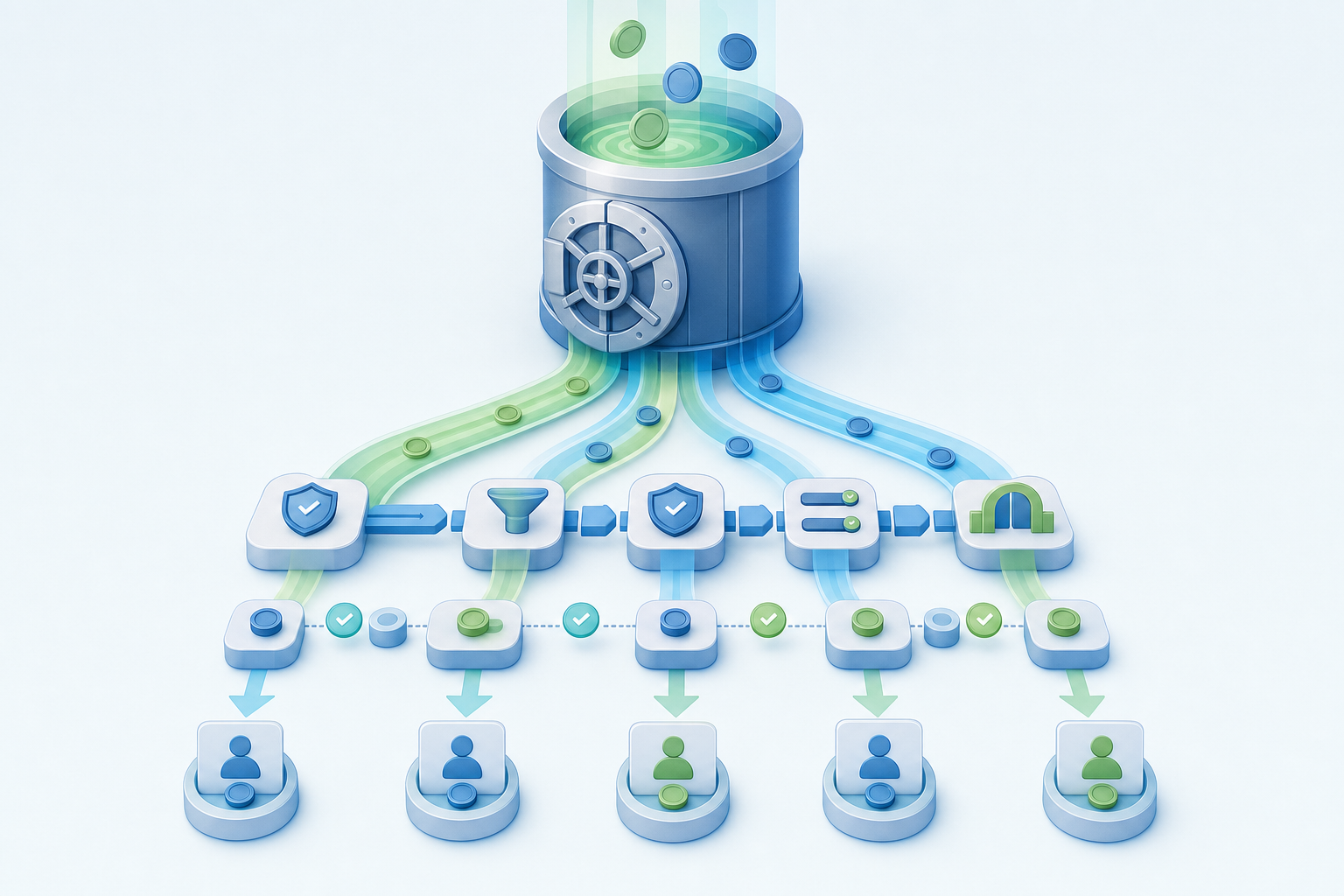
Moving funds from a group treasury to personal accounts introduces strict tax withholding that requires automating Form 1099 and W-8BEN collection
Tax and Compliance Challenges for Multi-Member Creator Operations
The creator space expands rapidly into a $205 billion global market. With this scale comes heavy regulatory friction. Founders often underestimate early administrative paperwork, including 1099-K requirements. As your participant count grows, legal obligations scale alongside it.
You must collect W-9 forms (taxpayer identification requests) from US-based members and W-8BEN forms from international participants before their first payout. Each quarter, you'll file 1099-MISC or 1099-NEC forms (miscellaneous income and nonemployee compensation reports) for domestic creators earning over $600 annually. International members trigger withholding obligations under IRS tax treaties, requiring you to apply country-specific rates and remit withheld amounts on schedule. Manual tracking breaks down fast once your collective hits a dozen active members across multiple jurisdictions.
Member Earnings Data: What Creators in Collectives Actually Make
Pooling your audience alters your baseline income potential. Participants earn 35 to 50% more annually than solo acts through mass payment solutions, according to 2026 CreatorIQ data. This premium comes directly from accessing larger sponsor deals with proper influencer payment structures
How Dots Handles Payout Infrastructure for Creator Networks
Managing creator network payments demands unified infrastructure. We built Dots to unify payee onboarding, KYC verification, tax collection, and disbursements under a single API contract. You skip stitching together separate compliance vendors.
Dots executes complex creator co-op payouts instantly. The API delivers:
- Real-time settlement via RTP (Real-Time Payments) and FedNow without instant surcharges
- Automated W-9 and 1099 collection with KYC (Know Your Customer) verification
- Multi-currency disbursement to 100+ countries
Final Thoughts on Creator Co-Op Payment Infrastructure
You can nail your revenue split formula and still lose members if payouts take two weeks. Compliance paperwork piles up fast when you're juggling W-9s, 1099s, and state tax rules across a dozen participants. The collectives that retain talent are the ones that pay members the same day a brand deal clears. When you're ready to stop manually wiring funds and chasing tax forms, Dots delivers real-time settlement and automated compliance.
FAQ
Can I build a creator co-op without forming a legal entity?
Yes, informal networks can cross-promote content and negotiate joint brand deals without registering as a formal cooperative. Once you pool revenue into a central treasury or distribute earnings through a shared brand revenue split, you'll need legal structure and compliance infrastructure to handle tax reporting and member payouts.
Creator co-op payouts equal split vs. performance-based: which works better?
Equal splits simplify accounting and keep group culture cohesive, but performance-based models reward growth and retain high earners. If your collective values stable membership and trust, equal distribution prevents resentment; if you need to scale quickly and attract top talent, performance-weighted creator co-op payouts align incentives with output.
How do you handle tax forms when paying multiple creators in different countries?
Dots Tax automates W-9 collection for US-based creators and W-8BEN collection for international members before their first payout. The API matches TINs (Taxpayer Identification Numbers), generates 1099s at year-end, and applies treaty-based withholding rates for non-US recipients: all under one contract, without manual paperwork.
What do creators in collectives actually earn compared to solo acts?
Participants in creator networks earn 35 to 50% more annually than solo creators, according to 2026 CreatorIQ data. This premium comes from accessing larger sponsor budgets through combined audiences and diversifying income beyond ad-network revenue into subscriptions, product sales, and direct brand partnerships.
How fast can creator network payments settle after a brand deal closes?
Dots executes creator network payments via RTP (Real-Time Payments) and FedNow with settlement under 30 seconds, at no instant surcharge. Once your collective approves the distribution vote and applies waterfall logic to calculate shares, funds move from the central treasury to individual creator accounts in real time.